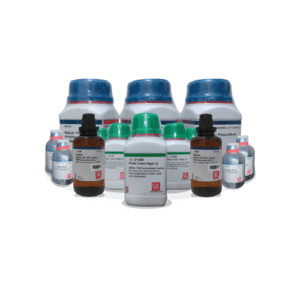
Description
Specifications Table
| Product Name | Barium Chloride Dihydrate pure, 99% | 78118 | SRL Chem |
|---|---|
| Pack Size | 500 Gms, 5 Kg |
| Form | Crystalline Powder |
| Grade | Lab Grade (99% Purity) |
| Application | Precipitation reactions, analytical chemistry, educational labs |
Product Description
Barium Chloride Dihydrate is a versatile inorganic compound widely used in laboratories for precipitation reactions, particularly in sulfate analysis. With a purity of 99%, this lab-grade chemical ensures accurate and reliable results in research and educational settings. Its high solubility in water makes it ideal for preparing standard solutions and conducting qualitative tests.
Whether you’re a student working on a chemistry project or a researcher performing analytical experiments, this Barium Chloride Dihydrate from SRL Chem delivers consistent performance. The crystalline powder form allows for easy handling and precise measurements, while its stability ensures long shelf life when stored properly.
Need high-quality lab chemicals for your experiments? Buy Barium Chloride Dihydrate online from eqipped today.
In educational laboratories, this compound serves as an excellent reagent for demonstrating chemical reactions and teaching fundamental concepts. Its role in forming insoluble barium sulfate precipitates makes it invaluable for sulfate detection tests. For industrial applications, it finds use in the manufacture of other barium salts and as a component in some specialty chemicals.
When working with Barium Chloride Dihydrate, always follow standard laboratory safety protocols. While it’s generally stable under normal conditions, proper storage in a cool, dry place away from incompatible substances is recommended to maintain its quality.
FAQs
What is the primary use of Barium Chloride Dihydrate in laboratories?
It’s mainly used for precipitation reactions, particularly in sulfate analysis, and as a reagent in various qualitative tests.
How should I store Barium Chloride Dihydrate?
Store in a tightly sealed container in a cool, dry place away from incompatible substances like strong acids.
What safety precautions should I take when handling this chemical?
Always wear gloves, safety goggles, and work in a well-ventilated area. Avoid ingestion and inhalation.
Can I use this for educational purposes?
Yes, it’s commonly used in school and college laboratories for chemistry experiments and demonstrations.
What’s the difference between anhydrous and dihydrate forms?
The dihydrate form contains two water molecules, making it more stable for general lab use compared to the anhydrous version.