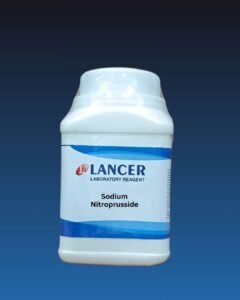
Description
Specifications Table
| Product Name | Sodium Nitroprusside | 1972 | Lancer |
|---|---|
| Quantity/Pack Size | 100 gm |
| Form | Powder |
| Grade | Lab Grade |
| Application | Analytical chemistry, research, education |
Product Description
Sodium Nitroprusside is a versatile chemical compound widely used in laboratories for analytical and research purposes. This high-purity lab-grade product from Lancer (Catalog No. 1972) is essential for experiments requiring precise chemical reactions. Whether you’re a student, researcher, or educator, this 100g pack ensures you have a reliable supply for your work.
Common applications include qualitative analysis, spectrophotometry, and biochemical assays. Its stability and solubility make it a preferred choice in academic and professional settings. When you buy Sodium Nitroprusside online from eqipped, you get a product that meets stringent quality standards, ensuring accurate and reproducible results.
Need Sodium Nitroprusside for your lab? Order now and get fast delivery across India.
Sodium Nitroprusside is particularly useful in detecting sulfide ions and other analytical procedures. Its bright red color in solution aids in visual confirmation of reactions, making it a valuable tool in educational labs. Researchers also use it in studies involving nitric oxide donors and vasodilation experiments.
At eqipped, we understand the importance of quality lab supplies. That’s why we source Sodium Nitroprusside from trusted manufacturers like Lancer, ensuring you receive a product that’s both pure and effective. Whether you’re setting up a new lab or restocking, this 100g pack offers great value for your investment.
FAQs
What is Sodium Nitroprusside used for in labs?
It’s primarily used for detecting sulfide ions, spectrophotometric analysis, and as a reagent in biochemical assays.
Is this Sodium Nitroprusside suitable for educational purposes?
Yes, its lab-grade purity makes it ideal for student experiments and academic research.
How should I store Sodium Nitroprusside?
Store in a tightly sealed container in a cool, dry place, away from light and moisture.
What safety precautions should I take?
Wear gloves, goggles, and a lab coat. Avoid inhalation and skin contact. Work in a fume hood if possible.
Can I buy Sodium Nitroprusside in bulk?
Yes, eqipped offers bulk quantities. Contact our support team for custom orders.