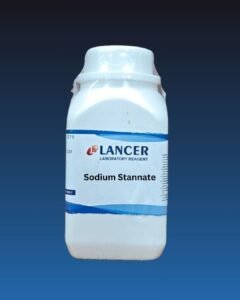
Description
Specifications Table
| Product Name | Sodium Stannate | 1980 | Lancer |
|---|---|
| Pack Size | 100 gm |
| Form | Powder |
| Grade | Laboratory Grade |
| Application | Electroplating, Corrosion Resistance, Chemical Synthesis |
Product Description
Sodium Stannate is a versatile chemical compound widely used in electroplating, corrosion inhibition, and various industrial applications. This laboratory-grade Sodium Stannate from Lancer (Product Code 1980) ensures high purity and consistent results, making it ideal for research, educational labs, and small-scale manufacturing.
Whether you’re a student working on a chemistry project or a researcher developing new coatings, this Sodium Stannate provides reliable performance. Its fine powder form dissolves easily, ensuring uniform distribution in solutions. Many users choose this product for its stability and effectiveness in tin plating processes.
At eqipped, we understand the importance of quality lab supplies. That’s why we source Sodium Stannate from trusted manufacturers like Lancer, ensuring you receive a product that meets strict laboratory standards. The 100g pack size offers convenience for small-scale experiments while maintaining cost-effectiveness.
Looking for high-purity Sodium Stannate for your next project? Order now and experience the difference quality makes.
For electroplating applications, Sodium Stannate serves as an excellent source of tin ions. It helps create durable, corrosion-resistant coatings on metals, which is crucial for automotive, aerospace, and electronics industries. Researchers also use it in chemical synthesis and as a mordant in textile dyeing processes.
The laboratory grade designation means this product undergoes rigorous quality control. You can trust it for accurate experimental results and consistent batch performance. Unlike technical-grade alternatives, this Sodium Stannate minimizes impurities that could interfere with sensitive reactions.
Students will appreciate how this product simplifies their lab work. The pre-measured 100g quantity reduces waste while providing enough material for multiple experiments. Educators can rely on its consistent quality when designing curriculum experiments.
Need a dependable Sodium Stannate supplier for your research needs? Shop now at eqipped for fast delivery across India.
Safety remains a priority when handling chemicals. While Sodium Stannate is generally stable, proper storage in a cool, dry place ensures longevity. Always use appropriate personal protective equipment when handling, and follow standard laboratory safety protocols.
For those exploring tin-based chemistry, this product offers an excellent starting point. Its versatility makes it valuable across multiple disciplines, from materials science to analytical chemistry. The powder form allows for precise measuring, which is essential for reproducible results.
eqipped makes purchasing lab chemicals straightforward. Our user-friendly platform lets you browse, compare, and order with confidence. We package all chemicals securely to prevent contamination during transit, so your Sodium Stannate arrives ready for immediate use.
FAQs
What is Sodium Stannate used for in laboratories?
Sodium Stannate serves primarily as a tin source in electroplating solutions, corrosion inhibitors, and chemical synthesis. Laboratories use it for creating tin coatings, preparing standards, and in various analytical procedures.
Is this Sodium Stannate suitable for educational experiments?
Yes, this laboratory-grade Sodium Stannate is perfect for educational settings. Its consistent quality ensures reliable results for student experiments in chemistry and materials science courses.
How should I store Sodium Stannate?
Store Sodium Stannate in a tightly sealed container in a cool, dry place away from moisture and incompatible substances. Proper storage maintains its stability and extends shelf life.
Can I use this for small-scale electroplating projects?
Absolutely. The 100g pack size is ideal for small-scale electroplating. Many hobbyists and small workshops use this product for tin plating jewelry, electronic components, and decorative items.
What safety precautions should I take when handling Sodium Stannate?
Wear appropriate PPE including gloves and safety goggles. Avoid inhalation and skin contact. Work in a well-ventilated area or under a fume hood when handling powdered chemicals.