Description
Specifications Table
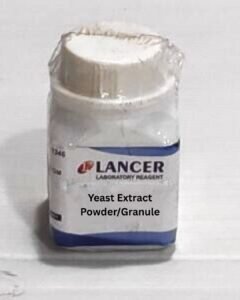
| Product Name | Yeast Granule | 2601 | Lancer |
|---|---|
| Pack Size | 100 gm |
| Form | Granules |
| Grade | Laboratory/Food Grade |
| Application | Baking, Microbiology, Fermentation Studies |
Product Description
When you need reliable yeast for your baking experiments or laboratory work, Yeast Granule | 2601 | Lancer delivers consistent performance. These high-quality granules provide excellent fermentation capabilities, making them ideal for both culinary and scientific applications.
Perfect for students working on microbiology projects or researchers studying fermentation processes, this yeast maintains its activity under standard conditions. The granular form ensures easy measurement and dissolution, whether you’re preparing dough for baking experiments or setting up culture media in the lab.
At eqipped, we understand the importance of quality reagents in educational and research settings. That’s why we offer this premium yeast granule that meets both food-grade and laboratory standards. The 100gm pack size provides sufficient quantity for multiple experiments while maintaining freshness.
Upgrade your lab supplies with Yeast Granule | 2601 | Lancer – order now for reliable fermentation results every time.
For baking applications, these granules activate quickly when hydrated, producing consistent carbon dioxide for proper dough rising. In laboratory settings, they serve as an excellent model organism for studying cellular processes and fermentation kinetics.
The product comes in a convenient 100gm pack that’s easy to store and portion. Whether you’re a student learning about yeast metabolism or a researcher developing new fermentation techniques, this yeast granule provides the reliability you need for accurate results.
Key Applications
Yeast Granule | 2601 | Lancer finds use in various educational and research applications:
Baking experiments in food science labs
Microbiology studies of yeast metabolism
Fermentation process optimization research
Bread-making demonstrations in culinary schools
Enzyme activity studies in biochemistry labs
Storage and Handling
To maintain optimal activity, store the yeast granules in a cool, dry place away from direct sunlight. For best results, use within the recommended shelf life period. When handling, ensure your workspace and equipment are clean to prevent contamination.
For laboratory use, always follow standard aseptic techniques when working with yeast cultures. The granules can be easily rehydrated in warm water (30-35°C) for activation before use in experiments.
Why This Product Stands Out
What makes Yeast Granule | 2601 | Lancer special is its dual suitability for both culinary and scientific applications. Unlike specialized lab strains that can’t be used for baking, or baking yeasts that lack laboratory consistency, this product bridges both worlds effectively.
The granular form offers precise measurement capabilities important for scientific reproducibility. At the same time, it maintains the robust fermentation characteristics needed for successful baking applications. This versatility makes it a valuable addition to any educational or research laboratory.
FAQs
What is the shelf life of Yeast Granule | 2601 | Lancer?
The product typically has a shelf life of 12-18 months when stored properly in its original packaging at room temperature.
Can this yeast be used for both baking and laboratory experiments?
Yes, this yeast granule is suitable for both applications, making it ideal for educational institutions that need versatile supplies.
How should I store the yeast granules to maintain their activity?
Store in a cool, dry place away from moisture and direct sunlight. For extended storage, consider refrigeration.
What’s the recommended hydration temperature for activation?
For optimal activation, hydrate the granules in warm water at 30-35°C for baking applications or as per your specific protocol.
Is this product suitable for gluten-free baking experiments?
While the yeast itself is gluten-free, always check your other ingredients and follow proper gluten-free protocols in your experiments.