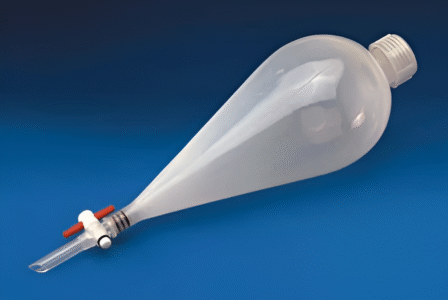
Description
Specifications Table
| Product Name | Separatory Funnel | 81201 | Polylab |
|---|---|
| Quantity/Pack Size | 100ml – 250ml – 500ml |
| Form | Glass |
| Grade | Laboratory Grade |
| Application | Liquid-liquid extraction, chemical separation |
Product Description
A separatory funnel is an essential tool in any chemistry lab, designed to separate immiscible liquids with precision. The Polylab separatory funnel, available in 100ml, 250ml, and 500ml sizes, is crafted from high-quality borosilicate glass for durability and chemical resistance. Whether you’re a student, researcher, or educator, this funnel ensures accurate and efficient separation every time.
Perfect for organic chemistry experiments, solvent extraction, and purification processes, this separatory funnel features a leak-proof stopcock and a sturdy glass construction. The tapered design allows for easy handling, while the ground glass stopper ensures a tight seal during mixing.
At eqipped, we understand the importance of reliable lab equipment. That’s why we offer this separatory funnel with a focus on quality and affordability. Whether you’re setting up a new lab or restocking, this funnel is a must-have for any workspace.
Upgrade your lab setup today with the Polylab separatory funnel. Order now for fast delivery across India.
FAQs
What is a separatory funnel used for?
A separatory funnel is used to separate two immiscible liquids based on their density differences. It’s commonly used in organic chemistry for liquid-liquid extraction.
Can I use a separatory funnel for hot liquids?
Yes, but ensure the glass is borosilicate to handle thermal stress. Avoid sudden temperature changes to prevent cracking.
How do I clean a separatory funnel?
Rinse with acetone or a suitable solvent, followed by distilled water. For stubborn residues, use a mild detergent and a brush.
Is the stopcock included with the funnel?
Yes, the Polylab separatory funnel comes with a leak-proof glass or PTFE stopcock for precise control.
Where can I buy a separatory funnel online in India?
You can buy separatory funnels online at eqipped, with options for 100ml, 250ml, and 500ml sizes. Shop now for lab-grade quality.