Description
Specifications
Product Name – Bacteriophage Model
Quantity/Pack Size – Single Unit
Form – 3D Viral Replica
Grade – Laboratory Grade
Application – Viral Structure Observation, Capsid and Tail Fiber Study, Laboratory Demonstration
product overview
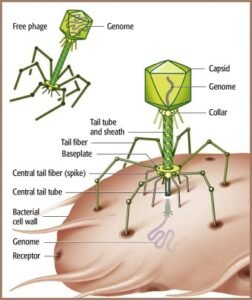
The Bacteriophage Model is a high-precision, laboratory-grade 3D representation of a bacterial virus, designed to illustrate structural intricacies with exceptional clarity. Constructed from durable, non-toxic materials, this model accurately portrays the phage’s head, capsid, tail, and tail fibers, emphasizing structural relationships and proportions. The head features distinct segmentation, highlighting the geometric arrangement of the viral capsid, while the tail fibers and base plate are engineered to demonstrate attachment mechanisms to host bacteria. The model’s detailed rendering allows for enhanced visual comprehension of viral morphology, making it suitable for detailed observation and demonstration purposes. Mounted on a sturdy base, it provides stability during handling and ensures safe, repeated laboratory use. The durable materials maintain structural integrity even with frequent manipulation, while the vivid coloration differentiates components for easy identification. Lightweight and compact, this model is convenient for transport, storage, and lab demonstration setups. Its accurate design focuses on proportional representation, fine detailing, and realistic depiction of viral anatomy, offering an effective visual tool for understanding bacteriophage structure. Ideal for laboratory visualization, this model supports observation, demonstrations, and comparative study of viral forms, combining durability, educational value, and precise anatomical representation in a single, high-quality laboratory-grade Bacteriophage Model.
FAQs
1. Does this model illustrate tail fiber attachments?
Yes, the tail fibers and base plate are accurately modeled to show attachment structures clearly.
2. Can it be used with other microbial models?
Yes, it is compatible with other laboratory-grade microbial and viral models for comparative study.
3. How should the model be stored?
Store in a dry, dust-free area away from direct sunlight to preserve structural integrity and colors.
4. Are alternative virus models available for laboratories?
Yes, models of T4 phage, Influenza virus, and other bacterial viruses are available for lab demonstrations.
5. Is this model durable for repeated handling?
Yes, it is made from robust laboratory-grade materials designed for frequent use in educational and research settings.