Description
Specifications
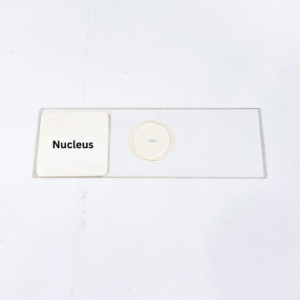
Product Name – Nucleus
Quantity/Pack Size – Single Preserved Specimen
Form – Whole Cell / Isolated Nucleus
Grade – Laboratory Grade
Application – Microscopy, Cell Structure Observation, Nucleic Content Analysis
product overview
The Nucleus preserved specimen provides a high-quality representation of the essential cellular organelle, maintaining the integrity of the nuclear membrane, nucleoplasm, and chromatin structures. Prepared using laboratory-grade preservation techniques, the specimen ensures that fine structural details are clearly visible under a microscope, facilitating detailed observation of nuclear architecture. The specimen is stabilized to prevent deformation, allowing accurate visualization of internal components such as nucleoli, chromatin arrangement, and nuclear matrix. Its ready-to-use format eliminates the need for additional preparation, making it convenient for immediate microscopic examination. Protective mounting ensures long-term stability, preserving morphological details for repeated study. The Nucleus specimen allows precise analysis of nuclear structure, including membrane organization and chromatin patterns, supporting detailed investigations into cellular morphology and structural relationships. The preserved organelle is suitable for high-resolution observation, providing consistent clarity over multiple uses. Designed for laboratory use, the specimen combines durability, clarity, and convenience, enabling efficient and reliable microscopic study. By maintaining structural fidelity and providing an easily observable format, this Nucleus preserved specimen is an essential resource for laboratories focusing on cell biology, microscopy, and detailed analysis of nuclear content and organization.
FAQs
1. What is the recommended magnification for observing the Nucleus?
Compound microscopes with 400x to 1000x magnification provide clear visualization of nuclear structures.
2. How should the Nucleus specimen be stored?
Store in a cool, dry place away from direct sunlight to maintain structural integrity.
3. Are there alternative preserved cell organelles available?
Yes, specimens such as mitochondria, chloroplasts, and whole cell slides are also available.
4. Can the specimen be observed multiple times?
Yes, careful handling allows repeated use without compromising clarity or morphology.
5. Is the specimen ready-to-use for microscopy?
Yes, it comes preserved and mounted, ready for immediate placement under a microscope.