Description
Specifications Table
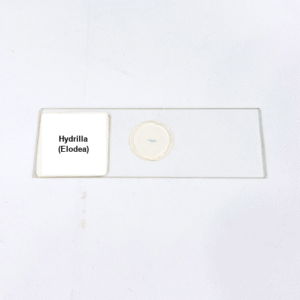
Product Name – Hydrilla (Elodea)
Quantity/Pack Size – 1 Slide
Form – Whole Mount
Grade – Laboratory Grade
Application – Observation of aquatic plant cellular structure and chloroplast arrangement under microscope
Product Overview
The Hydrilla (Elodea) slide provides a meticulously prepared whole mount of this freshwater aquatic plant, enabling detailed observation of cellular structures. The slide prominently displays key features including cell walls, chloroplasts, vacuoles, and cytoplasmic streaming, which are critical for studying photosynthesis and plant cell activity. The arrangement of chloroplasts within the cells allows observation of light-driven movement and distribution patterns, enhancing understanding of cellular physiology. Prepared under laboratory-grade standards, the slide ensures clarity, preservation, and durability for repeated use. The mounting medium stabilizes the tissue and prevents distortion, while staining highlights key internal structures, ensuring high visibility and contrast. This slide is compatible with standard laboratory microscopes, providing a clear representation of cellular morphology and organelle distribution. Each slide undergoes stringent quality checks to maintain consistency, clarity, and reliability. The Hydrilla (Elodea) slide is designed to offer precise visualization of plant cell structure, supporting in-depth microscopic analysis, and observation of dynamic cytoplasmic activity in living plant cells.
1. What cellular structures are visible on the Hydrilla Elodea slide?
Cell walls, chloroplasts, vacuoles, cytoplasm, and cytoplasmic streaming can be observed clearly for detailed plant cell analysis.
2. Can this slide be used with conventional microscopes?
Yes, it is fully compatible with standard laboratory optical microscopes for precise observation of plant cells.
3. Are there alternative aquatic plant slides available?
Yes, alternatives include Spirogyra, Vallisneria, and Lemna slides for comparative study of aquatic plant tissue structures.
4. How should the slide be stored for optimal preservation?
Store in a clean, dry place, protected from direct sunlight and moisture to maintain tissue quality and staining integrity.
5. Where are the Hydrilla specimens sourced from?
Specimens are collected from controlled aquatic environments and prepared under strict laboratory protocols for accuracy and reliability.