Description
Specifications Table
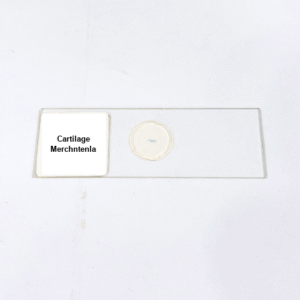
Product Name – Cartilage Merchentenla
Quantity/Pack Size – 1 Slide
Form – Mounted Slide
Grade – Laboratory Grade
Application – Microscopic examination of cartilage structure and cellular organization for detailed tissue analysis
Product Overview
The Cartilage Merchentenla slide is a carefully prepared, laboratory-grade specimen designed to reveal detailed features of cartilage tissue. The slide contains well-preserved cartilage sections, highlighting the matrix and chondrocytes arranged within lacunae. Special staining techniques are applied to enhance contrast between the extracellular matrix and cellular components, ensuring clear visibility of cellular morphology, including nuclei, cytoplasm, and pericellular matrix. The slide demonstrates the organization of cartilage layers, showing the distinction between the superficial, middle, and deep zones, along with the perichondrium where applicable. Structural integrity is maintained through meticulous mounting, preventing distortion or damage during handling. This slide is ideal for examining cartilage tissue at various magnifications, providing reliable representation of tissue architecture and cellular detail. High-quality preparation ensures consistent staining and durability, allowing repeated observations without degradation. The Cartilage Merchentenla slide is compatible with standard optical microscopes and is suitable for laboratory studies requiring precise visualization of cartilage morphology, offering a comprehensive view of tissue structure for scientific observation and analysis.
1. What cellular structures are visible on the Cartilage Merchentenla slide?
The slide displays chondrocytes within lacunae, extracellular matrix, and pericellular structures clearly for detailed observation.
2. Can this slide be used with all standard microscopes?
Yes, it is compatible with conventional optical microscopes for high-resolution microscopic examination.
3. Are there alternative slides for studying cartilage tissue?
Yes, alternatives include hyaline cartilage, fibrocartilage, and elastic cartilage slides for comparative analysis.
4. How should this slide be stored to maintain quality?
Keep in a dry, dust-free environment, away from direct sunlight, to preserve staining and tissue integrity.
5. What is the source of the cartilage tissue in this slide?
The cartilage tissue is collected from controlled laboratory sources and processed under strict protocols to maintain accurate structural representation.