Description
Specifications Table
Product Name – Mammal Large Intestine
Quantity/Pack Size – Single Slide
Form – Prepared Microscope Slide
Grade – Laboratory Grade
Application – Large Intestinal Tissue Structure Analysis
Product Overview
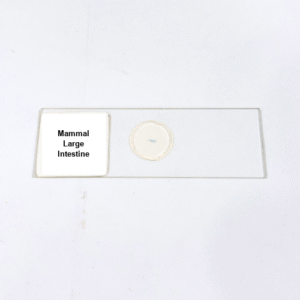
The Mammal Large Intestine prepared slide provides a comprehensive transverse view of intestinal tissue, enabling clear observation of mucosa, submucosa, muscularis, and serosa layers. The epithelial lining, crypts, and connective tissues are preserved to display accurate structural details, while smooth muscle arrangements and vascular components remain clearly visible. Mounted under a protective cover glass with high-quality mounting medium, the slide prevents air bubbles and artifact formation, ensuring long-term usability. Laboratory-grade preparation enhances optical clarity, contrast, and consistency for precise tissue analysis at varying magnifications. This slide allows detailed observation of epithelial organization, muscular layer orientation, and the structural arrangement of the intestinal mucosa for reliable microscopic examination. It is designed for durability, maintaining specimen quality for repeated use while supporting high-resolution visualization of tissue architecture. The preparation ensures that all anatomical layers of the large intestine are represented accurately, facilitating dependable study of tissue organization and structure for scientific and professional applications.
1. What magnification works best for this slide?
Optimal viewing is between 100x and 400x magnification to clearly observe mucosal folds and muscle layers.
2. How should the slide be stored?
Store in a dry, dust-free environment, away from direct sunlight to maintain tissue integrity and optical clarity.
3. Can this slide be used with digital microscopy systems?
Yes, it is compatible with digital microscopes for capturing high-resolution images of the tissue structure.
4. Are other mammalian digestive tissue slides available?
Yes, slides for small intestine, stomach, and other digestive organs are available for comprehensive study.
5. How is the tissue specimen sourced and prepared?
The tissue is ethically sourced and processed under controlled laboratory conditions to preserve structural details accurately.