Description
Specifications Table
| Product Name | Anatropous Ovule |
|---|---|
| Quantity/Pack Size | Single Slide |
| Form | Microscope Slide |
| Grade | Laboratory Grade |
| Application | Botany Studies, Research, Educational Labs |
Product Description
Understanding Anatropous Ovule: A Key Botanical Specimen
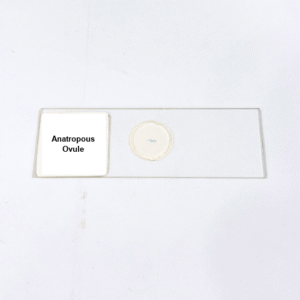
The Anatropous Ovule is a fundamental specimen in plant anatomy studies, widely used by students, researchers, and educators. This single-slide preparation offers a clear view of the ovule’s structure, making it essential for microscopy and botanical research. Whether you’re studying plant reproduction or conducting advanced research, this specimen provides the clarity and detail needed for accurate observations.
Why Choose Our Anatropous Ovule Slide?
When you buy Anatropous Ovule online from eqipped, you get a high-quality, laboratory-grade specimen that meets academic and research standards. Our slides are carefully prepared to ensure optimal visibility under the microscope, with precise staining and mounting. This makes them ideal for educational institutions, research labs, and individual students who need reliable specimens for their work.
Applications in Education and Research
Anatropous Ovules are commonly used in botany courses to teach plant morphology and reproduction. Researchers also rely on these specimens to study ovule development and fertilization processes. The single-slide format makes it easy to handle and store, ensuring longevity and repeated use in lab settings.
Buy Anatropous Ovule online today for precise, high-quality botanical specimens. Order now and enhance your lab studies with eqipped.
Key Features of Our Anatropous Ovule Slide
Our Anatropous Ovule slides are designed with the following features to ensure the best user experience:
- High-clarity glass slides for optimal microscopy
- Precise staining for clear structural visibility
- Durable mounting to prevent damage during handling
- Single-slide packaging for easy storage and organization
Who Should Buy This Product?
This Anatropous Ovule slide is perfect for:
- Botany students studying plant anatomy
- Researchers analyzing ovule development
- Educators teaching plant reproduction
- Lab technicians needing reliable specimens
How to Use the Anatropous Ovule Slide
Using this specimen is straightforward. Simply place the slide under a compound microscope and adjust the focus to observe the ovule’s structure. The staining highlights key features, making it easier to identify and study the anatropous orientation. For best results, use a microscope with at least 100x magnification.
FAQs
1. What is an Anatropous Ovule?
An Anatropous Ovule is a type of ovule where the body is inverted during development, with the micropyle near the base. It is commonly studied in botany for its role in plant reproduction.
2. How is this slide useful for students?
This slide provides a clear, microscopic view of the Anatropous Ovule, helping students understand its structure and function in plant reproduction. It is ideal for lab practicals and exams.
3. Can I buy Anatropous Ovule online in bulk?
Yes, eqipped offers bulk purchasing options for educational institutions and research labs. Contact our support team for customized quotes.
4. What magnification is recommended for viewing this slide?
A compound microscope with 100x to 400x magnification is ideal for observing the detailed structure of the Anatropous Ovule.
5. How should I store this slide?
Store the slide in a cool, dry place away from direct sunlight. Keep it in its original packaging or a slide box to prevent damage.