Description
Specifications Table
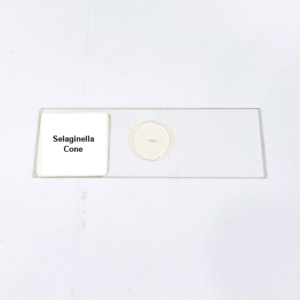
Product Name – Selaginella Cone
Quantity/Pack Size – Single Slide
Form – Prepared Microscope Slide
Grade – Laboratory Grade
Application – Observation of Strobilus and Sporangia Structure
Product Overview
The Selaginella Cone slide provides a meticulously prepared specimen of the strobilus, allowing clear observation of sporangia, spores, and supporting tissues. This slide is carefully sectioned to reveal the organization of microphylls, sporophylls, and sporangial clusters, providing detailed visualization of reproductive structures. High-quality staining enhances contrast between various tissues, highlighting sporangia development and spore arrangement with precision. The slide is mounted on durable glass, ensuring longevity and ease of handling while maintaining the natural morphology of the specimen. Protective mounting and packaging prevent contamination, moisture, or physical damage, preserving the integrity of the specimen. Each slide is prepared following strict laboratory standards, ensuring clarity, uniformity, and reproducibility under microscopic examination. The specimen is compatible with standard compound microscopes, enabling detailed study of Selaginella reproductive anatomy and strobilus morphology. It offers clear visibility of sporangial arrangement, microphyll distribution, and spore details, making it an excellent tool for detailed morphological studies. The laboratory-grade preparation ensures reliability for prolonged use, and the precision in sectioning and mounting provides consistent results across multiple observations. This slide is ideal for students, researchers, and educators seeking a high-quality, ready-to-use specimen for studying the intricate structures of Selaginella cones with exceptional clarity and detail.
1. What structures are visible on the Selaginella Cone slide?
The slide shows strobilus, sporangia, spores, and supporting microphylls with high clarity.
2. Is the slide compatible with all standard microscopes?
Yes, it can be used with standard laboratory compound and optical microscopes.
3. Are there alternative slides for comparison of reproductive structures?
Yes, Lycopodium Strobilus and Equisetum Cone slides serve as suitable alternatives.
4. How should the Selaginella Cone slide be stored?
Store in a clean, dry, and dust-free environment away from direct sunlight to preserve specimen integrity.
5. How is the Selaginella Cone slide prepared?
The slide is carefully sectioned, stained, and mounted to preserve sporangia, microphylls, and spore morphology accurately.