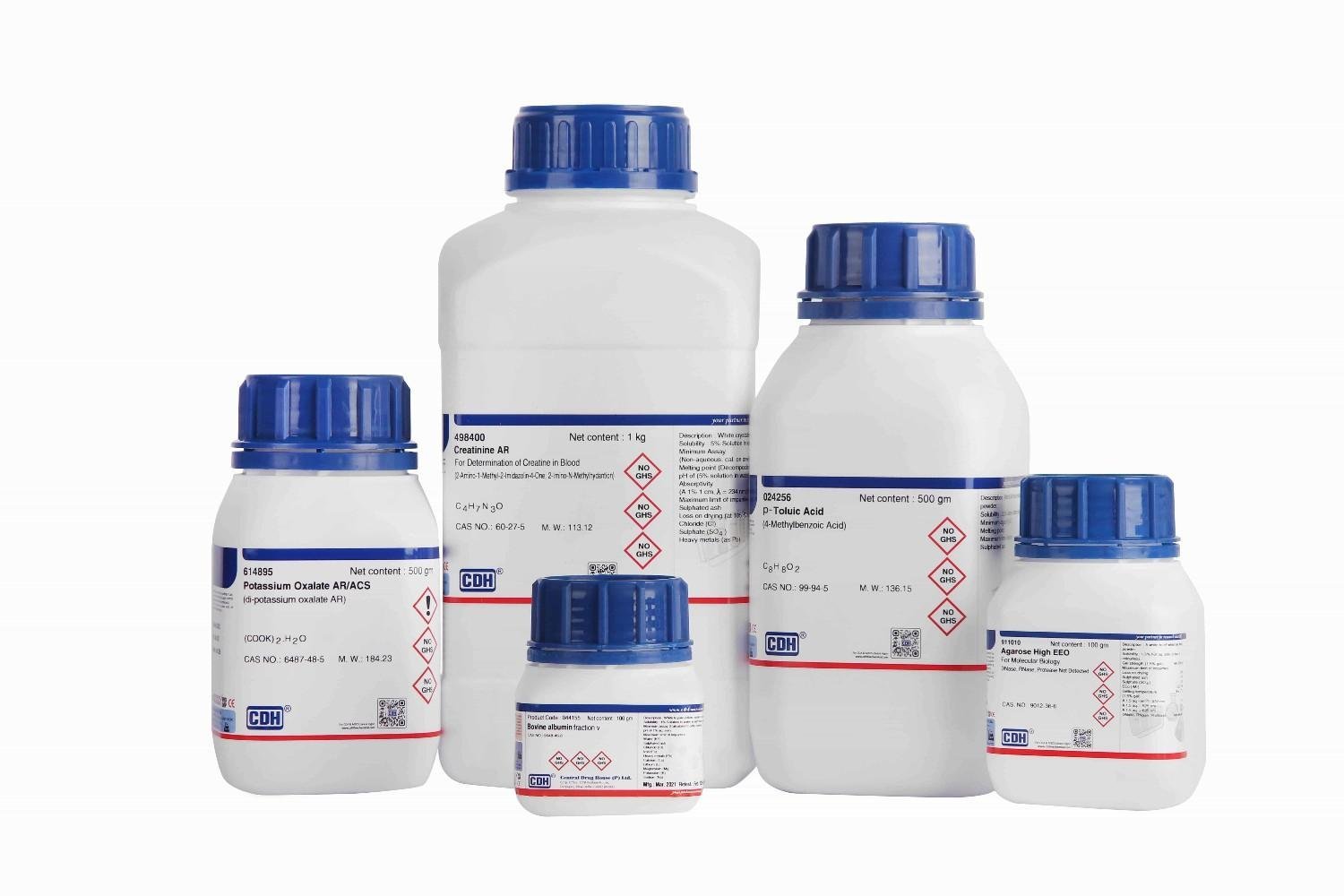
Description
Specifications Table
| Product Name | Di-Sodium Hydrogen Phosphate 1/15 mol/L (Buffer Stock Solution) |
|---|---|
| Pack Size | 500 mL |
| Form | Liquid |
| Grade | Analytical Reagent (AR) |
| Application | Buffer preparation, biochemical assays, molecular biology |
Product Description
When it comes to maintaining stable pH conditions in laboratory experiments, having a reliable buffer solution is non-negotiable. The Di-Sodium Hydrogen Phosphate 1/15 mol/L Buffer Stock Solution from CDH is a meticulously formulated reagent designed to deliver consistent performance in a wide range of applications. Whether you’re a student setting up your first biochemical assay or a seasoned researcher fine-tuning experimental conditions, this buffer solution ensures accuracy and reproducibility every time.
Buffer solutions play a critical role in experiments where pH fluctuations can compromise results. This particular formulation, with its 1/15 mol/L concentration, provides the ideal balance for creating working buffers at various pH levels. It’s particularly valued in molecular biology for DNA/RNA experiments, protein studies, and enzymatic reactions where precise pH control is essential.
The analytical reagent grade quality means you’re working with a product that meets stringent purity standards. Unlike technical-grade alternatives, this buffer solution minimizes the risk of contaminants interfering with your results. For researchers who demand consistency, this is a go-to choice for preparing phosphate-buffered saline (PBS) and other common laboratory buffers.
What sets this buffer apart is its versatility. From cell culture applications to chromatography techniques, its stable buffering capacity between pH 6.0 to 8.0 makes it indispensable. Students will appreciate how it simplifies buffer preparation for practical sessions, while educators can rely on it for consistent demonstration results.
At eqipped, we understand that lab supplies aren’t just products—they’re tools that directly impact your work’s success. That’s why we’ve made this high-quality buffer solution easily accessible for Indian researchers and students. Need a dependable phosphate buffer for your next experiment? This CDH buffer stock solution delivers professional-grade performance at a student-friendly price point.
Understanding Buffer Solutions in Laboratory Work
For those new to buffer solutions, here’s a quick primer: buffers resist pH changes when small amounts of acid or base are added. This Di-Sodium Hydrogen Phosphate solution serves as an excellent stock solution—you dilute it to create working buffers at your desired concentration. The 1/15 mol/L specification indicates its strength, making calculations straightforward when preparing different buffer systems.
Common applications include: – Preparing phosphate-buffered saline (PBS) for cell culture – Creating buffer systems for gel electrophoresis – Maintaining pH in enzymatic assays – Use in protein purification protocols – As a component in DNA extraction buffers
The beauty of this particular formulation lies in its sodium phosphate base, which provides excellent buffering capacity in the physiological pH range. This makes it especially valuable for experiments mimicking biological conditions.
Why This Buffer Stands Out
Not all buffer solutions are created equal. This CDH product offers several advantages that make it a smart choice for Indian labs:
First, the pre-dissolved format saves valuable time—no weighing or mixing required. For busy researchers and students juggling multiple experiments, this convenience translates to more efficient workflows. The solution comes ready-to-use, ensuring consistent results without the variability that can come from manual preparation.
Second, the AR grade purity means fewer impurities that could potentially interfere with sensitive assays. When working with techniques like PCR or protein quantification, even trace contaminants can skew results. This buffer’s high purity helps maintain the integrity of your experimental data.
Finally, the 500 mL pack size strikes a perfect balance—large enough for regular use in teaching labs yet compact enough for individual research projects. It’s an ideal quantity for most academic and small-scale research applications.
Practical Tips for Using This Buffer Solution
To get the most out of your Di-Sodium Hydrogen Phosphate buffer:
1. Storage matters: Keep the solution at room temperature, but always check for any precipitation before use. If crystals form, gentle warming and mixing can restore the solution.
2. Dilution calculations: Remember that this is a stock solution. For most applications, you’ll need to dilute it further. A simple calculation based on your target molarity will give you the right dilution ratio.
3. Compatibility check: While versatile, always verify that phosphate buffers are suitable for your specific assay. Some applications may require alternative buffer systems.
4. Label clearly: Once prepared, label your working buffers with concentration, date, and intended use to avoid mix-ups in the lab.
Looking for a buffer solution that combines reliability with ease of use? This Di-Sodium Hydrogen Phosphate stock solution from CDH delivers professional-grade performance for all your laboratory buffering needs.
Safety Considerations
While generally safe when handled properly, all laboratory chemicals require careful handling:
– Always wear appropriate personal protective equipment (gloves, goggles) – Avoid skin and eye contact – In case of contact, rinse thoroughly with water – Store in a cool, dry place away from incompatible substances – Keep container tightly closed when not in use
FAQs
What is the shelf life of this buffer solution?
When stored properly at room temperature, this buffer solution typically maintains its stability for 12-24 months. Always check for any signs of contamination or precipitation before use.
Can I use this buffer for cell culture applications?
Yes, this Di-Sodium Hydrogen Phosphate solution is commonly used in preparing PBS for cell culture. However, you may need to supplement it with other components like potassium chloride and sodium chloride for complete PBS formulation.
How do I prepare a 0.1 M phosphate buffer from this stock solution?
Since this is a 1/15 mol/L solution (approximately 0.067 M), you would need to use about 1.5 times the volume of stock solution to achieve 0.1 M concentration. Always verify calculations for your specific application.
Is this buffer solution sterile?
This product is not supplied sterile. If sterility is required for your application, you’ll need to filter-sterilize the solution using a 0.22 μm membrane filter before use.
What’s the difference between this and regular sodium phosphate dibasic?
This is a pre-prepared buffer stock solution at a specific concentration (1/15 mol/L), while sodium phosphate dibasic is typically sold as a dry powder. The buffer solution saves preparation time and ensures consistent results.