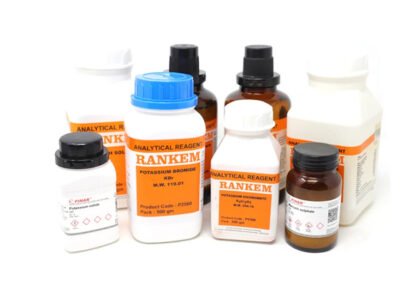
Description
Specifications Table
| Product Name | 1-Octanesulfonic acid sodium salt, monohydrate HPLC | RANKO2015 | Avantor |
|---|---|
| Pack Size | 25 g |
| Form | Solid (monohydrate) |
| Grade | HPLC |
| Application | Ion pair chromatography, HPLC mobile phase additive |
Product Description
1-Octanesulfonic acid sodium salt monohydrate is a high-purity reagent designed for ion pair chromatography in HPLC applications. This compound is widely used in laboratories to improve the separation of ionic and polar compounds, making it essential for researchers and analysts working with complex samples. Whether you’re analyzing pharmaceuticals, environmental samples, or biological fluids, this reagent ensures reliable and reproducible results.
As an ion pair reagent, it forms stable complexes with charged analytes, enhancing their retention and resolution on reverse-phase HPLC columns. The monohydrate form ensures consistent performance, while the HPLC grade guarantees minimal impurities that could interfere with your analysis. If you’re looking to buy 1-octanesulfonic acid sodium salt monohydrate online, eqipped offers a trusted source for high-quality lab supplies.
This product is particularly useful in methods requiring precise control over retention times, such as the analysis of nucleotides, organic acids, or cationic drugs. Its compatibility with common HPLC solvents like methanol and acetonitrile makes it a versatile choice for various chromatographic conditions.
Upgrade your HPLC separations with this high-performance ion pair reagent. Shop now at eqipped for reliable lab supplies.
FAQs
What is 1-octanesulfonic acid sodium salt used for in HPLC?
It is primarily used as an ion pair reagent to improve the separation of ionic compounds in reverse-phase HPLC by forming neutral complexes with charged analytes.
Is this product suitable for LC-MS applications?
While it can be used in LC-MS, it is important to ensure compatibility with your mass spectrometer, as ion pair reagents may cause ion suppression or contamination.
How should I prepare the mobile phase with this reagent?
Dissolve the required amount in the aqueous component of your mobile phase (e.g., water or buffer) before mixing with organic solvents like methanol or acetonitrile.
What is the shelf life of this product?
When stored properly in a sealed container at room temperature, it remains stable for at least two years from the date of manufacture.
Can I use this for GC applications?
No, this reagent is specifically designed for HPLC ion pair chromatography and is not suitable for gas chromatography (GC).