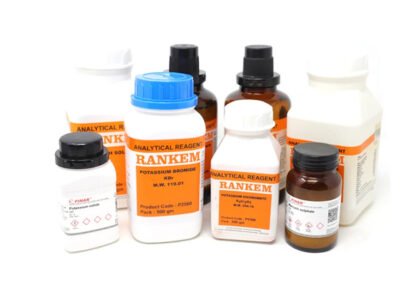
Description
Specifications Table
| Product Name | Ammonium bicarbonate LR |
|---|---|
| Quantity/Pack Size | 500 g |
| Form | Powder |
| Grade | LR (Laboratory Reagent) |
| Application | Lab experiments, buffer preparation, chemical synthesis |
Product Description
Ammonium bicarbonate LR is a versatile laboratory chemical widely used in research, education, and industrial applications. This high-purity grade ensures reliable results in analytical procedures, buffer solutions, and synthesis reactions. Whether you’re a student conducting experiments or a researcher developing new formulations, this product delivers consistent performance.
At eqipped, we source premium chemicals from trusted suppliers like Avantor to meet the stringent demands of modern laboratories. The LR grade guarantees minimal impurities, making it suitable for sensitive applications where precision matters.
Need ammonium bicarbonate for your next experiment? Buy online now and get it delivered to your lab quickly.
The powder form allows for easy dissolution in water, forming a clear solution that’s essential for various biochemical and chemical processes. It’s particularly useful in food chemistry experiments, pharmaceutical research, and educational demonstrations.
For institutions and individuals looking to buy ammonium bicarbonate in India, eqipped offers competitive pricing and reliable supply. Our platform makes it simple to order lab chemicals online with just a few clicks.
FAQs
What is the purity level of this ammonium bicarbonate?
This product meets LR (Laboratory Reagent) grade standards, ensuring high purity suitable for most lab applications.
Can I use this for food-related experiments?
Yes, the LR grade is appropriate for food chemistry experiments, though not intended for direct consumption.
How should I store ammonium bicarbonate?
Keep it in a tightly sealed container in a cool, dry place to prevent moisture absorption and decomposition.
What’s the shelf life of this product?
When stored properly, ammonium bicarbonate LR maintains its quality for at least 2 years from manufacture date.
Does eqipped offer bulk discounts on this product?
Yes, we provide competitive pricing for bulk orders. Contact our support team for quantity-based quotes.