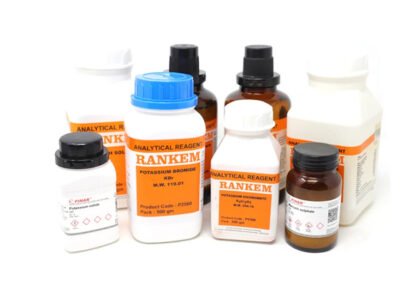
Description
Specifications Table
| Product Name | Palladium(II) chloride AR |
|---|---|
| Quantity/Pack Size | 1 g |
| Form | Powder |
| Grade | AR (Analytical Reagent) |
| Application | Catalysis, organic synthesis, analytical chemistry |
Product Description
Palladium(II) chloride AR is a high-purity chemical compound widely used in laboratories for catalysis, organic synthesis, and analytical applications. This analytical reagent grade ensures minimal impurities, making it suitable for precise research and experimental work. Whether you’re a student, researcher, or educator, this product delivers consistent performance in various chemical reactions.
At eqipped, we provide lab supplies that meet the highest standards of quality and reliability. Our Palladium(II) chloride AR is sourced from trusted manufacturers, ensuring you get a product that meets your experimental needs without compromise.
Need high-purity Palladium(II) chloride for your lab? Buy online now for fast and secure delivery.
This compound is particularly valuable in cross-coupling reactions, such as the Suzuki-Miyaura coupling, where palladium catalysts play a crucial role. Its solubility in water and organic solvents makes it versatile for different laboratory protocols. Researchers in organic chemistry, materials science, and pharmaceutical development often rely on this reagent for its efficiency and reproducibility.
When handling Palladium(II) chloride, it’s essential to follow proper lab safety protocols. Always wear appropriate personal protective equipment (PPE), including gloves and goggles, and work in a well-ventilated area or fume hood. Store the chemical in a cool, dry place away from incompatible substances to maintain its stability.
FAQs
What is the purity level of Palladium(II) chloride AR?
This product meets analytical reagent (AR) grade standards, ensuring high purity suitable for laboratory and research applications.
Can I use this for catalytic reactions?
Yes, Palladium(II) chloride AR is commonly used as a precursor for palladium catalysts in organic synthesis and cross-coupling reactions.
How should I store this chemical?
Store in a tightly sealed container in a cool, dry place, away from moisture and incompatible substances.
Is this product available in larger quantities?
Currently, we offer a 1 g pack size. For bulk requirements, please contact our customer support team.
What safety precautions should I take when using Palladium(II) chloride?
Wear appropriate PPE, work in a fume hood, and follow standard lab safety protocols to avoid exposure.