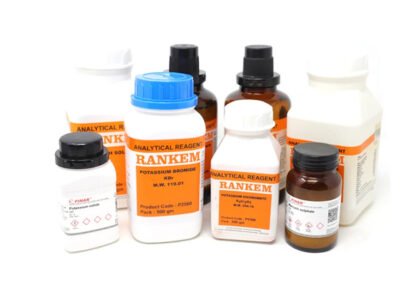
Description
Specifications Table
| Product Name | Sodium Thiosulfate, Pentahydrate LR |
|---|---|
| Pack Size | 500g |
| Form | Crystalline Powder |
| Grade | LR (Laboratory Reagent) |
| Application | Titration, Iodometry, Photography, Water Treatment |
Product Description
Sodium Thiosulfate Pentahydrate is a versatile laboratory chemical widely used in analytical chemistry, photography, and industrial applications. This LR-grade variant ensures high purity and consistency, making it ideal for precise titrations, iodine value determinations, and chlorine neutralization in water treatment.
In research labs, it serves as a reducing agent and complexing agent, while photographers rely on it for fixing images. Its stable crystalline form dissolves easily in water, providing accurate results in volumetric analysis. Whether you’re a student, educator, or researcher, this chemical is a staple for experiments requiring reliable redox reactions.
At eqipped, we source this product from Avantor, a trusted name in lab supplies, ensuring you receive a product that meets stringent quality standards. The 500g pack size offers convenience for both small-scale and bulk usage, reducing the need for frequent reordering.
Need Sodium Thiosulfate for your next experiment? Buy online now for guaranteed purity and fast shipping across India.
FAQs
What is the shelf life of Sodium Thiosulfate Pentahydrate?
When stored properly in a sealed container, it remains stable for up to 2 years. However, solutions should be prepared fresh for critical titrations.
Can I use this for home water testing?
Yes, it’s commonly used in DIY water test kits to measure chlorine levels. Ensure you follow the kit instructions for accurate readings.
Is this product suitable for food industry applications?
No, this LR-grade variant is intended for lab and technical use only. Food-grade Sodium Thiosulfate requires additional certifications.
How do I prepare a 0.1N Sodium Thiosulfate solution?
Dissolve 24.82g of the pentahydrate in 1L of distilled water. Standardize the solution against a primary standard like potassium dichromate for precision.
Where can I buy Sodium Thiosulfate Pentahydrate in India?
You can buy Sodium Thiosulfate Pentahydrate online at eqipped with pan-India delivery. We offer competitive pricing and bulk discounts for educational institutions.