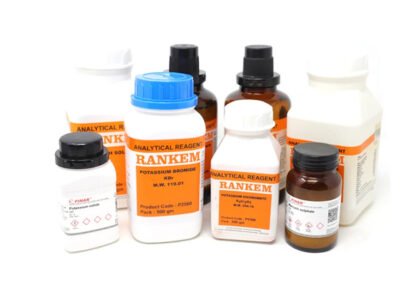
Description
Specifications Table
| Product Name | Thymolphthalein indicator powder |
|---|---|
| Pack Size | 25g |
| Form | Powder |
| Grade | Laboratory Reagent |
| Application | pH indicator in titrations, educational labs |
Product Description
Thymolphthalein indicator powder is a widely used pH indicator in laboratories and educational settings. This high-quality powder from Avantor ensures reliable color changes, making it perfect for titration experiments and acid-base reactions. When dissolved in alcohol, it transitions from colorless in acidic solutions to blue in alkaline conditions, providing clear visual confirmation of pH levels.
Whether you’re a student conducting experiments or a researcher needing precise pH detection, this thymolphthalein powder delivers consistent results. Its fine powder form allows for easy dissolution and accurate measurements, making it a staple in chemistry labs across India.
At eqipped, we source only premium lab supplies to support your scientific work. This thymolphthalein indicator powder meets stringent quality standards, ensuring you get dependable performance every time.
How to Use Thymolphthalein Indicator Powder
To prepare a thymolphthalein solution, dissolve a small amount of the powder in ethanol or another suitable solvent. The typical concentration used in labs is 0.1% (w/v). Add a few drops of this solution to your sample during titration. The color change from colorless to blue indicates the endpoint of the reaction, helping you determine the exact pH or concentration of your solution.
For best results, store the powder in a cool, dry place away from direct sunlight. Always use protective gear like gloves and goggles when handling chemical indicators.
Applications of Thymolphthalein Powder
This versatile indicator powder is commonly used in:
- Acid-base titrations in analytical chemistry
- Educational demonstrations of pH concepts
- Research applications requiring precise pH monitoring
- Quality control processes in pharmaceutical and food industries
Its sharp color transition makes it particularly useful in experiments where visual clarity is essential. Many Indian universities and research institutions rely on thymolphthalein for its accuracy and ease of use.
Why Thymolphthalein is a Preferred pH Indicator
Unlike some other indicators, thymolphthalein has a very distinct color change, reducing ambiguity in results. Its transition range (pH 9.3–10.5) makes it ideal for detecting weak bases and strong acids. The powder form also offers better shelf life compared to pre-made solutions, allowing you to prepare fresh indicator as needed.
When you buy thymolphthalein powder from eqipped, you’re getting a product trusted by professionals. Our seamless online ordering process ensures you receive your lab supplies quickly, so you can focus on your experiments without delays.
FAQs
What is the shelf life of thymolphthalein indicator powder?
When stored properly in a sealed container away from moisture and light, thymolphthalein powder can last for several years without significant degradation.
Can I use thymolphthalein for food testing?
While it’s primarily used in lab settings, thymolphthalein is non-toxic in small quantities. However, it’s not approved as a food additive, so its use should be limited to analytical purposes.
How much thymolphthalein powder do I need for a titration?
A 0.1% solution is standard for most applications. For a 100ml solution, you would dissolve 0.1g of the powder in ethanol.
Is thymolphthalein safe to handle?
While generally low-risk, it’s always recommended to wear gloves and safety goggles when handling any chemical powder. Avoid inhalation and contact with skin.
Where can I buy authentic thymolphthalein powder in India?
You can buy genuine Avantor thymolphthalein indicator powder online at eqipped with assured quality and fast delivery across India.