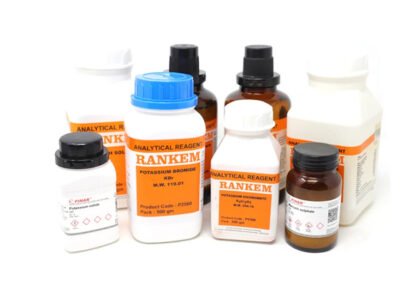
Description
Specifications Table
| Product Name | Thymolphthalein Indicator Solution |
|---|---|
| Quantity/Pack Size | 100 mL |
| Form | Liquid (Solution) |
| Grade | Laboratory Reagent |
| Application | pH indicator for titrations and acid-base experiments |
Product Description
Thymolphthalein Indicator Solution is a widely used pH indicator in laboratories, particularly for titrations and acid-base experiments. This solution, formulated at 1% w/v in ethanol, remains colorless in acidic and neutral conditions but turns a distinct blue in alkaline environments (pH 9.3–10.5). Its sharp color change makes it ideal for precise endpoint detection in analytical chemistry.
Whether you’re a student conducting experiments or a researcher ensuring accurate results, this indicator solution from Avantor (RANKT0361) delivers consistent performance. The high-purity formulation minimizes interference, ensuring reliable readings every time. For those looking to buy thymolphthalein indicator online, eqipped offers a seamless purchasing experience with authentic lab supplies.
Need a reliable pH indicator for your lab? Shop Thymolphthalein Indicator Solution now for accurate titrations.
The solution is stable under normal storage conditions, but prolonged exposure to light or heat may affect its efficacy. Always store it in a cool, dark place to maintain its shelf life. If you’re searching for a thymolphthalein solution supplier, eqipped ensures genuine Avantor products with fast delivery across India.
FAQs
What is the pH range for thymolphthalein indicator?
Thymolphthalein transitions from colorless to blue between pH 9.3 and 10.5, making it ideal for detecting alkaline conditions.
How should I store thymolphthalein solution?
Store the solution in a cool, dark place to prevent degradation. Avoid exposure to direct sunlight or heat.
Can I use this indicator for food testing?
No, this product is intended for laboratory use only and is not food-grade certified.
Where can I buy thymolphthalein indicator solution online?
You can purchase authentic Thymolphthalein Indicator Solution from eqipped, ensuring quality and fast delivery.
Is this solution suitable for student lab experiments?
Yes, it is commonly used in educational settings for acid-base titrations and pH demonstrations.