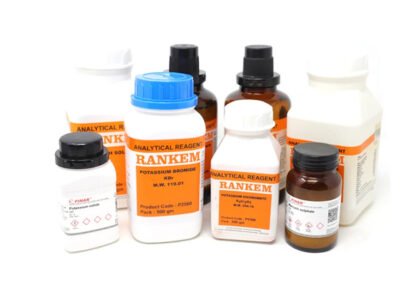
Description
Specifications Table
| Product Name | Tripotassium citrate, monohydrate LR |
|---|---|
| Pack Size | 500g |
| Form | Powder |
| Grade | LR (Laboratory Reagent) |
| Application | Buffer preparation, biochemical research, analytical chemistry |
Product Description
Tripotassium citrate monohydrate LR is a high-quality laboratory reagent widely used in research and analytical applications. This water-soluble salt serves as an effective buffering agent, helping maintain stable pH levels in biochemical assays and cell culture media. Its LR grade ensures reliability in sensitive experiments, making it a staple in academic and industrial labs.
Whether you’re preparing citrate buffers for electrophoresis or conducting enzymatic studies, this compound delivers consistent performance. Researchers and students alike trust its purity for accurate results. At eqipped, we provide lab-grade chemicals sourced from reputable manufacturers like Avantor, ensuring you get the best for your experiments.
Need a reliable supplier for lab chemicals? Buy Tripotassium citrate monohydrate LR online at eqipped for hassle-free procurement.
In medical and pharmaceutical research, tripotassium citrate plays a role in studying kidney stone formation and urinary alkalization. Its non-toxic nature and compatibility with biological systems make it suitable for in vitro diagnostics and drug formulation studies. The monohydrate form offers better solubility compared to anhydrous variants, simplifying solution preparation.
For educators, this chemical serves as an excellent teaching tool in chemistry labs, demonstrating concepts like pH buffering and ionic interactions. Its stability under standard lab conditions ensures safe handling for students while maintaining experimental integrity.
FAQs
What is the difference between LR grade and AR grade tripotassium citrate?
LR (Laboratory Reagent) grade is suitable for general lab use, while AR (Analytical Reagent) grade meets higher purity standards for precise analytical work. For most research applications, LR grade provides sufficient purity.
Can I use this for food or pharmaceutical manufacturing?
No, this LR grade product is intended solely for laboratory use. Food or pharmaceutical applications require different grades with specific certifications.
How should I store tripotassium citrate monohydrate?
Store in a tightly sealed container at room temperature, away from moisture and direct sunlight. Proper storage maintains stability for at least 2 years.
What’s the solubility of this compound in water?
Tripotassium citrate monohydrate is highly soluble in water (about 1g/1.5mL), making it easy to prepare solutions of various concentrations.
Where can I buy authentic tripotassium citrate for my lab?
You can purchase genuine LR grade tripotassium citrate monohydrate online at eqipped, with assured quality and prompt delivery across India.