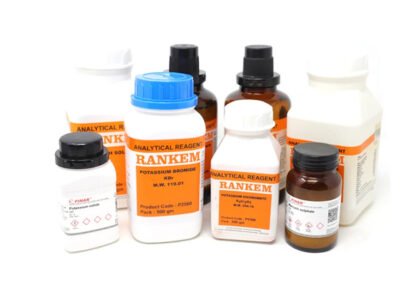
Description
Specifications Table
| Product Name | Ammonium cerium(IV) nitrate GPR RECTAPUR® |
|---|---|
| Pack Size | 1 kg |
| Form | Crystalline powder |
| Grade | GPR (General Purpose Reagent) |
| Application | Oxidation reactions, titrations, analytical chemistry |
Product Description
Ammonium cerium(IV) nitrate is a powerful oxidizing agent widely used in laboratories for redox titrations, organic synthesis, and analytical procedures. The GPR RECTAPUR® grade ensures high purity and consistency, making it ideal for research, education, and industrial applications. Whether you’re conducting cerimetric titrations or synthesizing organic compounds, this reagent delivers reliable results.
At eqipped, we provide lab-grade chemicals sourced from trusted suppliers like Avantor, ensuring you get products that meet stringent quality standards. This 1 kg pack is perfect for frequent use in academic labs, research facilities, and quality control testing.
Need a dependable oxidizing agent for your lab? Buy ammonium cerium nitrate online from eqipped today.
Key Applications
Ammonium cerium(IV) nitrate is versatile in laboratory settings. It is commonly used for:
- Oxidation of organic compounds in synthesis
- Cerimetric titrations for quantitative analysis
- Electrochemical studies and redox reactions
- Catalytic applications in organic chemistry
Safety and Handling
This chemical is a strong oxidizer and should be handled with care. Always wear appropriate PPE, including gloves and goggles, when working with ammonium cerium(IV) nitrate. Store in a cool, dry place away from flammable materials and reducing agents.
Why This Product Stands Out
The GPR RECTAPUR® grade from Avantor guarantees minimal impurities, ensuring accurate and reproducible results in your experiments. Unlike lower-grade alternatives, this product is specifically designed for laboratory use, providing consistency batch after batch. Researchers and educators trust this reagent for its stability and effectiveness in demanding applications.
Looking for a trusted ammonium cerium nitrate supplier? Shop now at eqipped for authentic lab chemicals.
FAQs
What is ammonium cerium(IV) nitrate used for in labs?
It is primarily used as an oxidizing agent in redox titrations, organic synthesis, and analytical chemistry due to its strong oxidizing properties.
Is this product suitable for educational labs?
Yes, the GPR grade is ideal for academic settings, offering reliable performance for student experiments and research projects.
How should I store ammonium cerium(IV) nitrate?
Store in a tightly sealed container in a cool, dry place, away from incompatible substances like organic materials and reducing agents.
Can I buy ammonium cerium nitrate in smaller quantities?
This listing is for a 1 kg pack, but eqipped offers flexible options for bulk and smaller quantities based on availability.
What safety precautions are necessary when handling this chemical?
Wear nitrile gloves, safety goggles, and a lab coat. Avoid contact with skin and eyes, and work in a well-ventilated area or fume hood.