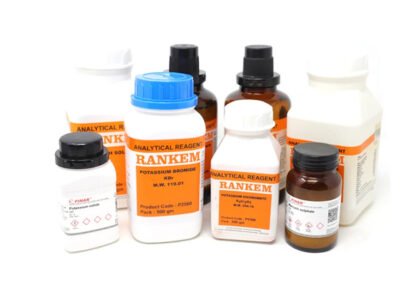
Description
Specifications Table
| Product Name | Potassium, 1000 ppm ICP-ML, single-element standard |
|---|---|
| Pack Size | 100 ml |
| Form | Liquid solution |
| Grade | ICP-ML (Traceable to NIST SRM) |
| Application | ICP-OES, ICP-AES, atomic spectroscopy |
Product Description
When precision matters in your lab, this potassium 1000 ppm ICP standard delivers reliable results every time. Designed for inductively coupled plasma (ICP) techniques, this single-element solution ensures accurate calibration and validation of your instrumentation. Whether you’re a student running routine experiments or a researcher pushing the boundaries of analytical chemistry, this standard helps eliminate guesswork.
The 1000 ppm potassium standard is prepared in a high-purity matrix, minimizing interferences and ensuring stability over time. Each batch undergoes rigorous quality control, so you can trust the consistency of your data. The 100 ml pack size offers an optimal balance between cost efficiency and sufficient volume for multiple analyses.
For labs in India, eqipped provides this standard with fast shipping and proper documentation, so you can focus on your work without supply chain delays. The traceability to NIST standards means your results meet international compliance requirements, whether for academic research or industrial testing.
Upgrade your ICP analysis with this high-precision potassium standard—order today and experience the difference in your data quality.
FAQs
What is the shelf life of this potassium ICP standard?
When stored properly at room temperature, this standard remains stable for at least 24 months from the date of manufacture.
Can I use this for both ICP-OES and ICP-MS?
Yes, this 1000 ppm potassium standard is suitable for both ICP-OES and ICP-MS applications, though you may need to dilute it further for ICP-MS depending on your instrument’s sensitivity.
Is this standard compatible with organic matrices?
While designed for aqueous solutions, it can be used in organic matrices with proper sample preparation techniques. Always validate with your specific protocol.
How should I prepare working standards from this solution?
Use serial dilution with high-purity water or appropriate matrix-matched solutions. A typical starting point is a 10x dilution to achieve 100 ppm working standard.
Does eqipped provide a certificate of analysis with this product?
Yes, every batch includes a detailed certificate of analysis with concentration values, expiration date, and traceability information.