Description
Specifications Table
| Product Name | LCR Q Meter (Bridge Type) | AE 492 | ASICO |
|---|---|
| Pack Size | 1 Unit |
| Form | Electronic Instrument |
| Grade | Laboratory Grade |
| Application | LCR measurements, Q-factor testing, electronics research |
Product Description
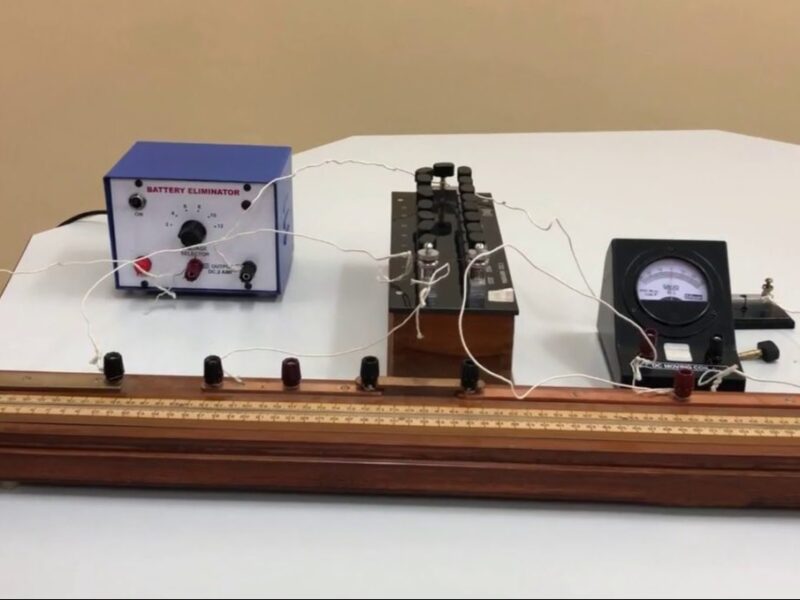
The LCR Q Meter (Bridge Type) | AE 492 | ASICO is a high-precision instrument designed for accurate measurements of inductance (L), capacitance (C), and resistance (R). This bridge-type meter is widely used in electronics labs, research facilities, and educational institutions for testing components and circuits. Whether you’re a student, researcher, or educator, this LCR meter ensures reliable and consistent results for your experiments.
Built with advanced circuitry, the AE 492 model offers exceptional stability and accuracy, making it one of the best LCR meters for lab use. Its user-friendly interface allows for easy operation, while its robust construction ensures durability even in demanding environments. If you’re looking to buy an LCR Q meter online, this model is an excellent choice for both professional and academic applications.
At eqipped, we understand the importance of precision in laboratory work. That’s why we offer this high-quality LCR meter at a competitive price, ensuring you get the best value for your investment. Whether you’re setting up a new lab or upgrading your existing equipment, this LCR Q meter is a must-have for accurate component testing.
Upgrade your lab with the LCR Q Meter (Bridge Type) | AE 492 | ASICO. Order now for precise measurements every time.
Key Applications
This LCR meter is ideal for a variety of applications, including:
- Testing inductors, capacitors, and resistors in electronics circuits.
- Measuring Q-factor (quality factor) of coils and resonant circuits.
- Educational purposes in physics and electronics laboratories.
- Research and development in electrical engineering.
Why This LCR Meter Stands Out
The AE 492 model is designed with precision in mind. Unlike basic multimeters, this bridge-type LCR meter provides highly accurate readings, making it suitable for critical applications. Its compact design and easy-to-read display ensure convenience, while its durable build guarantees long-term reliability.
For students and researchers, this LCR meter is an invaluable tool for experiments involving passive components. Educators can also use it to demonstrate fundamental concepts in electrical engineering, ensuring students gain hands-on experience with professional-grade equipment.
Looking for the best LCR meter for your lab? The AE 492 model offers unmatched accuracy and ease of use. Buy online today at eqipped.
How to Use the LCR Q Meter
Using this LCR meter is straightforward. Simply connect the component to the designated terminals, select the measurement mode (L, C, or R), and read the value from the display. The bridge-type design ensures minimal error, providing reliable results for your tests.
For best results, calibrate the meter before use and ensure the component under test is properly connected. The included manual provides detailed instructions for setup and operation, making it easy even for beginners.
Maintenance and Care
To ensure longevity, store the LCR meter in a dry, dust-free environment. Avoid exposing it to extreme temperatures or humidity. Regularly check the terminals for corrosion and clean them with a soft cloth if necessary. With proper care, this instrument will serve you reliably for years.
FAQs
What is an LCR Q meter used for?
An LCR Q meter measures inductance (L), capacitance (C), and resistance (R), as well as the Q-factor of components. It’s essential for testing and designing electronic circuits.
Is this LCR meter suitable for educational labs?
Yes, the AE 492 model is ideal for educational purposes, offering precise measurements for student experiments and demonstrations.
Can I buy this LCR meter online in India?
Absolutely! You can purchase the LCR Q Meter (Bridge Type) | AE 492 | ASICO directly from eqipped with fast shipping across India.
What makes this the best LCR meter for lab use?
Its high precision, durability, and ease of use make it a top choice for labs. The bridge-type design ensures accurate readings for critical applications.
Does this LCR meter come with a warranty?
Yes, eqipped provides a standard warranty on all lab instruments, including this LCR meter. Check the product page for details.