Description
Specifications Table
| Product Name | Quantity/Pack Size | Form | Grade | Application |
|---|---|---|---|---|
| Faraday’s Effect with He-Ne Laser | AE 1036 | ASICO | 1 Kit | Experimental Setup | Laboratory Grade | Physics Education, Magnetic Field Studies |
Product Description
The Faraday effect experiment setup with a He-Ne laser is a fundamental tool for demonstrating how magnetic fields influence light polarization. This kit, designed for educational and research purposes, provides a hands-on approach to understanding magnetism and optics. Whether you’re a student, educator, or researcher, this setup offers precise measurements and clear visualizations of the Faraday effect.
At eqipped, we ensure that every component of this kit meets laboratory standards, making it reliable for consistent results. The He-Ne laser provides a stable light source, while the included polarizers and magnetic field apparatus allow for accurate observations. This setup is widely used in physics labs to study the interaction between light and magnetic fields, making it an essential addition to any educational or research facility.
If you’re looking to buy a Faraday effect kit online, this setup is an excellent choice for both beginners and advanced users. The kit includes all necessary components, ensuring you can start your experiments immediately without additional purchases. For those searching for a He-Ne laser experiment setup, this product delivers both quality and ease of use.
Experience the Faraday effect firsthand with this comprehensive kit. Buy online now for a seamless learning experience.
The Faraday effect, discovered by Michael Faraday in 1845, describes how a magnetic field can rotate the plane of polarization of light. This phenomenon is crucial in various scientific applications, including optical isolators and magnetic field sensors. By using this kit, you can replicate Faraday’s experiments and gain deeper insights into electromagnetism.
For educators, this setup serves as an engaging teaching tool, helping students visualize abstract concepts in physics. Researchers can also benefit from its precision, using it to validate theoretical models or conduct advanced studies. The kit’s design ensures safety and durability, making it suitable for long-term use in academic and professional settings.
When you buy this Faraday effect kit with laser online, you’re investing in a product that combines educational value with practical utility. The He-Ne laser provides a coherent light source, while the magnetic field components allow for adjustable experiments. This versatility makes it a valuable asset for any lab focused on optics and magnetism.
At eqipped, we prioritize quality and customer satisfaction. This kit is no exception, offering a robust and user-friendly design that meets the needs of modern laboratories. Whether you’re setting up a new lab or upgrading existing equipment, this Faraday effect experiment setup is a smart choice.
FAQs
What is the Faraday effect?
The Faraday effect is a magnet-optical phenomenon where the plane of polarization of light rotates when it passes through a material in the presence of a magnetic field.
How does the He-Ne laser enhance the experiment?
The He-Ne laser provides a stable and coherent light source, making it easier to observe and measure the polarization rotation caused by the magnetic field.
Is this kit suitable for high school labs?
Yes, this kit is designed for educational use and is suitable for high school, college, and university physics labs.
Can I buy this Faraday effect kit online?
Absolutely! You can purchase this kit directly from eqipped for a hassle-free shopping experience.
What components are included in the kit?
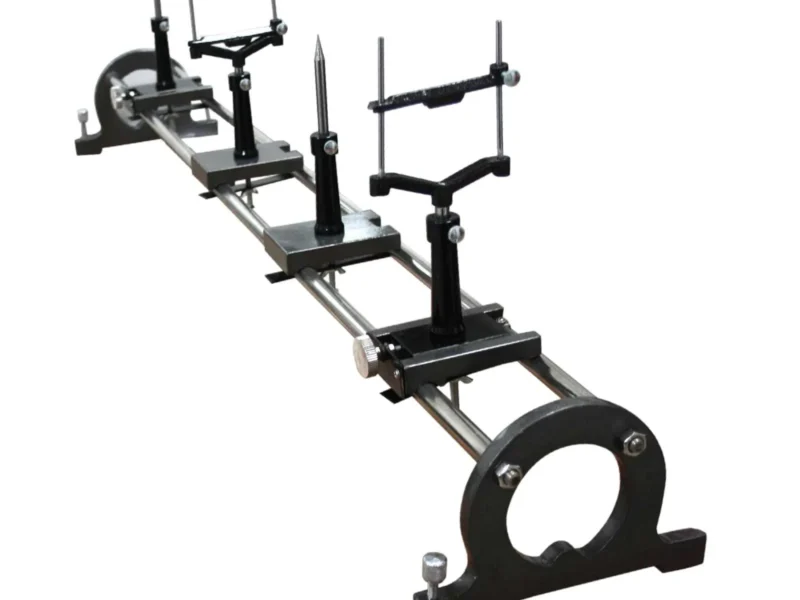
The kit includes a He-Ne laser, polarizers, a magnetic field apparatus, and detailed instructions for conducting the experiment.