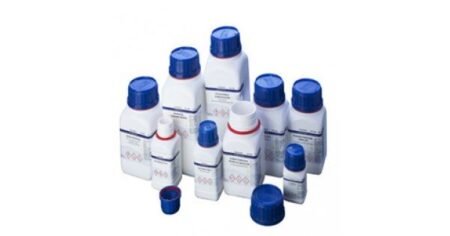
Description
Specifications Table
| Product Name | ACETONITRILE GC Reference Standard | GS008 |
|---|---|
| Quantity/Pack Size | 100 ml |
| Form | Liquid |
| Grade | HPLC Grade |
| Application | GC analysis, chromatographic calibration, research |
Product Description
When precision matters in gas chromatography (GC) or high-performance liquid chromatography (HPLC), the quality of your solvents can make or break your results. The ACETONITRILE GC Reference Standard (GS008) from Loba Chemie is designed for researchers, students, and lab professionals who demand consistency and accuracy in their analytical work.
This HPLC-grade acetonitrile serves as a reliable reference standard for calibration, method development, and quality control in chromatographic applications. Whether you’re validating a new protocol or ensuring batch-to-batch consistency in your lab, this solvent delivers the purity and performance you need.
Unlike technical-grade acetonitrile, this reference standard undergoes rigorous purification to eliminate impurities that could interfere with your analysis. It’s particularly useful in pharmaceutical testing, environmental analysis, and academic research where trace-level contaminants can skew data.
Need a dependable solvent for your GC or HPLC workflow? Order ACETONITRILE GC Reference Standard online today and experience the difference precision makes.
Why This Standard Matters in Your Lab
Using a dedicated GC reference standard like this one ensures your instrument’s performance is benchmarked against a known, stable baseline. Here’s how it helps:
Calibration Accuracy: Reference standards help fine-tune your GC or HPLC system, reducing errors in retention time and peak area measurements.
Method Validation: When developing new analytical methods, a high-purity standard confirms your protocol’s reliability before applying it to real samples.
Quality Assurance: In industries like pharmaceuticals or food testing, reference standards are critical for meeting regulatory compliance and audit requirements.
At eqipped, we understand that even the smallest details in your lab supplies can impact your work. That’s why we stock only verified, high-grade chemicals like this Loba Chemie standard—so you can focus on your research without worrying about solvent quality.
Applications in Research and Industry
This acetonitrile reference standard is versatile enough for multiple applications, including:
Pharmaceutical Analysis: Used in drug purity testing and impurity profiling where precise solvent behavior is non-negotiable.
Environmental Testing: Helps quantify pollutants in water or soil samples when paired with GC-MS or HPLC systems.
Academic Research: Ideal for student projects or thesis work requiring reproducible chromatographic data.
Food and Beverage Safety: Employed in detecting residues, additives, or contaminants in compliance with food safety standards.
If you’re setting up a new lab or upgrading your existing supplies, this standard is a smart addition to your inventory. Shop now and ensure your next experiment starts on the right foot.
Handling and Storage Guidelines
While acetonitrile is a common lab solvent, proper handling ensures safety and longevity:
Storage: Keep the bottle tightly sealed in a cool, well-ventilated area away from direct sunlight or heat sources. Store at room temperature (15–25°C).
Shelf Life: When stored correctly, this standard remains stable for up to 24 months from the date of manufacture. Always check the label for expiration details.
Safety Note: Acetonitrile is flammable and toxic if ingested or inhaled. Use in a fume hood, wear appropriate PPE (gloves, goggles), and avoid skin contact. Dispose of waste according to local hazardous material regulations.
Frequently Asked Questions (FAQs)
1. What is ACETONITRILE GC Reference Standard used for?
ACETONITRILE GC Reference Standard is used as a certified reference material for gas chromatography (GC) applications, including instrument calibration, method validation, system suitability testing, and analytical quality control. It is traceable to the USP Reference Standard and is intended for laboratory use.
2. What is the purity of ACETONITRILE GC Reference Standard GS008?
The product has a minimum purity of 99.8% (by GC), ensuring high accuracy and reproducibility for chromatographic analyses.
3. Is this product suitable for analytical and research laboratories?
Yes. It is suitable for analytical testing, pharmaceutical quality control, research laboratories, environmental testing, and other applications that require a high-purity GC reference standard.
4. How should ACETONITRILE GC Reference Standard be stored?
Store the product in its original, tightly sealed container in a cool, dry, and well-ventilated area away from heat sources, sparks, open flames, and incompatible substances. Since acetonitrile is highly flammable, appropriate chemical storage guidelines should always be followed.
5. What precautions should be taken while handling this product?
Wear suitable personal protective equipment (PPE), including chemical-resistant gloves, safety goggles, and a laboratory coat. Handle the material in a well-ventilated area or fume hood, avoid inhalation and skin contact, and follow the Safety Data Sheet (SDS) recommendations during use.