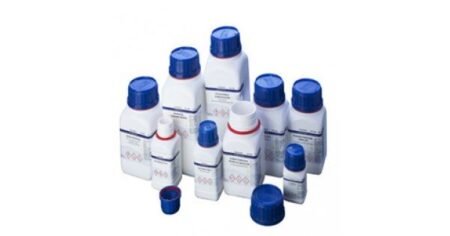
Description
Specifications Table
| Product Name | Conductivity Standard 60000 µS/cm traceable to NIST |
|---|---|
| Pack Size | 500 ml |
| Form | Liquid |
| Grade | Analytical |
| Application | Calibration of conductivity meters |
Product Description
When it comes to precise conductivity measurements, accuracy is non-negotiable. The Conductivity Standard 60000 µS/cm traceable to NIST from Loba Chemie ensures your lab equipment delivers reliable results every time. Whether you’re a student, researcher, or educator, this high-range conductivity standard is designed to meet the strictest calibration requirements.
Conductivity meters are only as good as their calibration standards. A slight deviation can lead to incorrect readings, affecting experiments, quality control, or research outcomes. This NIST-traceable standard eliminates guesswork, providing a benchmark you can trust. It’s particularly useful in industries where high conductivity levels are critical, such as wastewater treatment, pharmaceuticals, or chemical manufacturing.
At eqipped, we understand the importance of precision in lab work. That’s why we offer this conductivity standard from Loba Chemie, a brand synonymous with quality and consistency. The 500 ml pack size ensures you have enough for multiple calibrations without frequent reordering.
Need a conductivity standard that guarantees accuracy? Buy Conductivity Standard 60000 µS/cm NIST traceable online today and calibrate with confidence.
Using this standard is straightforward. Simply follow your meter’s calibration procedure, and you’ll have a reference point that aligns with international standards. It’s compatible with most conductivity meters, making it a versatile choice for labs of all sizes.
For educators, this standard is an excellent tool for teaching students about conductivity principles. Its high range (60000 µS/cm) allows for demonstrations of extreme conductivity scenarios, helping students grasp the concept more effectively.
Researchers working on projects involving electrolytes, brines, or industrial effluents will find this standard indispensable. It ensures that your data is accurate, repeatable, and defensible—critical for peer-reviewed studies or regulatory compliance.
Don’t compromise on calibration. Order Conductivity Standard 60000 µS/cm NIST traceable now and ensure your lab’s measurements are always precise.
FAQs
What is the shelf life of this conductivity standard?
The Conductivity Standard 60000 µS/cm has a shelf life of 12 months when stored properly in a cool, dry place.
Can this standard be used with any conductivity meter?
Yes, it is compatible with most conductivity meters that support calibration with high-range standards.
How often should I calibrate my conductivity meter?
For best results, calibrate your meter before each use or at least once a week, depending on usage frequency.
Is this standard suitable for educational labs?
Absolutely. Its high range makes it ideal for teaching conductivity principles in academic settings.
Where can I buy Conductivity Standard 60000 µS/cm NIST traceable online?
You can purchase it directly from eqipped, ensuring authentic Loba Chemie products with reliable delivery.