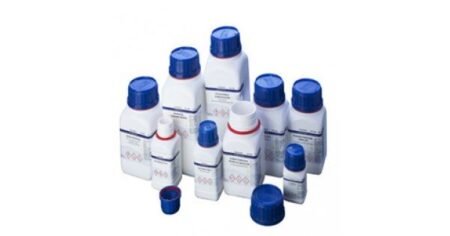
Description
Specifications Table
| Product Name | DEVARDA’S ALLOY Extra Pure DEVARDA’S ALLOY POWDER AR |
|---|---|
| Pack Size | 500 g, 1 kg, 2 kg |
| Form | Powder |
| Grade | AR (Analytical Reagent) |
| Application | Nitrogen determination, redox reactions, laboratory analysis |
Product Description
DEVARDA’S ALLOY is a specialized copper-aluminum-zinc alloy widely used in analytical chemistry for nitrogen determination in organic compounds. This extra pure powder, graded as AR (Analytical Reagent), ensures high accuracy in laboratory applications. Whether you’re a student, researcher, or educator, this alloy is essential for precise redox reactions and qualitative analysis.
At eqipped, we provide lab-grade DEVARDA’S ALLOY in convenient pack sizes of 500 g, 1 kg, and 2 kg, catering to both small-scale experiments and bulk requirements. The fine powder form allows for easy dissolution and uniform reaction, making it ideal for Kjeldahl digestion and other analytical procedures.
Looking for reliable DEVARDA’S ALLOY for your lab? Buy online now for authentic quality and fast shipping.
Key Applications
DEVARDA’S ALLOY is primarily used in:
- Nitrogen estimation in organic samples via Kjeldahl method.
- Reducing agents in redox titrations.
- Qualitative analysis in educational and research laboratories.
Why This Product Stands Out
This AR-grade alloy from Loba Chemie (Product Code: 03161) is manufactured under strict quality controls to ensure consistency and purity. Unlike industrial-grade alternatives, this extra pure powder minimizes impurities, reducing experimental errors. Its fine particle size enhances reactivity, making it a preferred choice for sensitive analytical work.
Need DEVARDA’S ALLOY for your next experiment? Shop now at eqipped for genuine lab supplies.
Safety and Handling
While DEVARDA’S ALLOY is generally stable, it should be handled with care in a well-ventilated laboratory. Avoid inhalation of dust and direct contact with skin or eyes. Store in a cool, dry place away from oxidizing agents. Always follow standard lab safety protocols when using this product.
FAQs
What is DEVARDA’S ALLOY used for?
It is primarily used in analytical chemistry for nitrogen determination in organic compounds, particularly in the Kjeldahl method.
Is this alloy suitable for educational labs?
Yes, its AR grade and fine powder form make it ideal for both research and educational laboratory applications.
What pack sizes are available?
You can buy DEVARDA’S ALLOY in 500 g, 1 kg, and 2 kg packs to suit your requirements.
How should I store this product?
Store in a tightly sealed container in a cool, dry place, away from moisture and oxidizing agents.
Where can I buy authentic DEVARDA’S ALLOY online?
eqipped offers genuine Loba Chemie DEVARDA’S ALLOY with fast delivery across India. Order now for reliable quality.