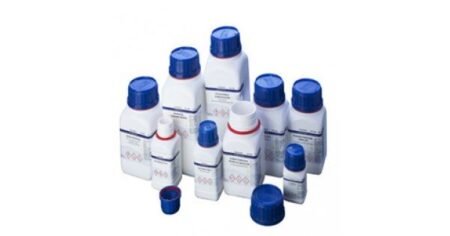
Description
Specifications Table
| Product Name | CITRIC ACID MONOHYDRATE 99.5–102% AR/ACS |
|---|---|
| Pack Size | 500 g, 5000 g |
| Form | Crystalline Powder |
| Grade | AR/ACS |
| Application | Buffering agent, chelating agent, biochemical research |
Product Description
Citric Acid Monohydrate is a versatile organic acid widely used in laboratories for its excellent buffering capacity and chelating properties. With a purity of 99.5–102%, this AR/ACS-grade citric acid ensures reliable results in analytical and research applications. Whether you’re preparing buffer solutions, conducting enzymatic assays, or synthesizing compounds, this high-quality reagent delivers consistency and accuracy.
Available in convenient pack sizes of 500 g and 5000 g, eqipped makes it easy to buy citric acid monohydrate online for both small-scale experiments and bulk requirements. The crystalline powder form dissolves easily in water, making it ideal for various lab protocols.
Need high-purity citric acid for your research? Order now and get lab-grade quality delivered to your doorstep.
FAQs
What is the difference between AR and ACS grade citric acid?
AR grade meets analytical reagent standards, while ACS grade adheres to American Chemical Society specifications. Both ensure high purity, but ACS is often preferred for strict compliance requirements.
Can I use this citric acid for food applications?
This product is lab-grade and not intended for food use. For food applications, consider food-grade citric acid available separately.
How do I prepare a 0.1M citric acid buffer?
Dissolve 21.01 g of citric acid monohydrate in 1L of distilled water, then adjust pH with sodium hydroxide as needed.
Is this citric acid suitable for DNA extraction?
Yes, its chelating properties help remove metal ions that may interfere with nucleic acid isolation.
What is the shelf life of citric acid monohydrate?
When stored properly in a sealed container, it remains stable for 2–3 years. Check the batch-specific expiry date on the label.