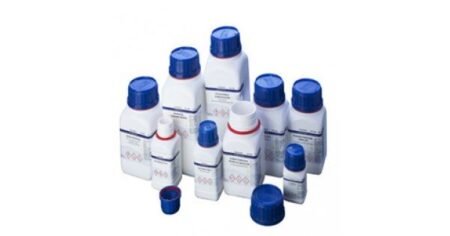
Description
Specifications Table
| Product Name | 1-(2-Hydroxyethyl) Piperidine 98.5% For Synthesis | 04125 | Loba Chemie |
|---|---|
| Pack Size | 100 ml, 500 ml |
| Form | Liquid |
| Grade | For Synthesis |
| Application | Organic synthesis, pharmaceutical research, chemical intermediates |
Product Description
1-(2-Hydroxyethyl) Piperidine 98.5% is a high-purity chemical compound widely used in organic synthesis and pharmaceutical research. This versatile reagent serves as a key building block in the preparation of various pharmaceutical intermediates, agrochemicals, and specialty chemicals. With a purity of 98.5%, it ensures reliable results in laboratory applications, making it a preferred choice for researchers and chemists.
The compound features a piperidine ring with a hydroxyethyl substituent, offering unique reactivity in nucleophilic substitutions, alkylations, and other organic transformations. Its stability and solubility in common organic solvents further enhance its utility in synthetic chemistry.
Whether you’re working on drug discovery, material science, or academic research, this chemical provides the consistency and performance needed for high-impact experiments. eqipped offers this product in convenient pack sizes of 100 ml and 500 ml, ensuring you have the right quantity for your lab requirements.
Upgrade your lab inventory with premium-grade 1-(2-Hydroxyethyl) Piperidine 98.5%—order now for seamless synthesis.
FAQs
What is the purity of 1-(2-Hydroxyethyl) Piperidine offered by eqipped?
The product has a minimum purity of 98.5%, making it suitable for high-precision synthesis.
Can this chemical be used in pharmaceutical research?
Yes, it is commonly used as an intermediate in pharmaceutical synthesis due to its reactive properties.
What are the available pack sizes for this product?
You can purchase it in 100 ml or 500 ml bottles, depending on your lab’s needs.
How should I store 1-(2-Hydroxyethyl) Piperidine?
Store it in a tightly sealed container in a cool, dry place, away from direct sunlight and moisture.
Is this product suitable for academic research?
Absolutely. Its high purity and consistent quality make it ideal for academic and industrial research applications.