Description
Specifications Table
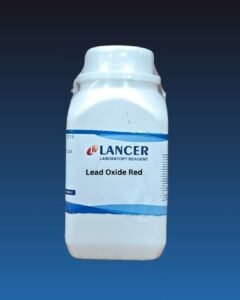
| Product Name | Lead Oxide Red | 1222 | Lancer |
|---|---|
| Pack Size | 500 gm |
| Form | Powder |
| Grade | Lab Grade |
| Application | Analytical, Research, Educational Labs |
Product Description
Lead Oxide Red, also known as red lead or minium, is a high-quality inorganic compound widely used in laboratories for analytical and research purposes. This lab-grade red lead oxide is sourced from Lancer, ensuring consistency and reliability in your experiments. Whether you’re a student, researcher, or educator, this product is designed to meet your precise requirements.
With its vibrant red-orange color and fine powder form, Lead Oxide Red | 1222 | Lancer is ideal for applications such as corrosion protection studies, pigment analysis, and chemical synthesis. Its high purity makes it suitable for sensitive analytical procedures where accuracy is critical.
At eqipped, we understand the importance of quality lab supplies. That’s why we offer this lead oxide red in a convenient 500 gm pack size, ensuring you have enough for multiple experiments without excess waste. Our seamless online ordering process makes it easy to buy lead oxide for lab use, with fast shipping across India.
Need reliable lab-grade red lead oxide for your experiments? Order Lead Oxide Red | 1222 | Lancer today and experience hassle-free delivery.
Lead Oxide Red is commonly used in educational institutions and research labs due to its stability and versatility. It serves as a key reagent in various chemical reactions and is often employed in the preparation of other lead compounds. The lab-grade quality ensures minimal impurities, providing accurate and reproducible results in your work.
When handling this product, always follow standard laboratory safety protocols. Store it in a cool, dry place away from incompatible substances. For best results, use appropriate personal protective equipment (PPE) such as gloves and goggles when working with lead compounds.
FAQs
What is the purity level of this Lead Oxide Red?
This product is lab-grade, typically with a purity of 98% or higher, making it suitable for analytical and research applications.
Can this be used for industrial applications?
While it’s primarily designed for lab use, it can be used in small-scale industrial applications where high purity is required.
How should I store this product?
Store in a cool, dry place in a tightly sealed container. Keep away from moisture and incompatible substances like strong acids.
Is this product suitable for educational experiments?
Yes, it’s commonly used in educational settings for chemistry experiments and demonstrations.
What safety precautions should I take when using this?
Always wear gloves, goggles, and work in a well-ventilated area. Avoid inhalation and skin contact. Follow standard lab safety protocols.