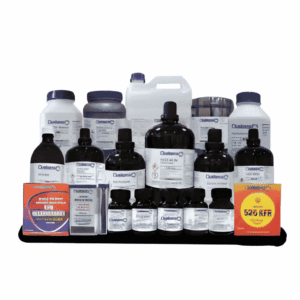
Description
Specifications Table
| Product Name | 1-Pentane Sulphonic Acid Monohyd. HPLC | Q19192 | Qualigens |
|---|---|
| Pack Size | 25 GM |
| Form | Solid |
| Grade | HPLC |
| Application | Ion-pair chromatography, analytical research |
Product Description
When precision matters in your HPLC workflow, 1-pentane sulphonic acid monohydrate from Qualigens delivers the purity and consistency you need. This high-grade reagent is specifically designed for ion-pair chromatography, ensuring reliable separation and accurate results in analytical laboratories. Whether you’re a student working on a research project or a professional running routine analyses, this product meets the stringent requirements of HPLC applications.
At eqipped, we understand the importance of quality reagents in scientific work. That’s why we source this product from Qualigens, a trusted name in laboratory chemicals. The monohydrate form ensures stability, while the HPLC grade guarantees minimal impurities that could interfere with your results. It’s the ideal choice for researchers who demand reproducibility in their chromatographic separations.
Need HPLC-grade reagents for your lab? Explore our full range of chromatography supplies at eqipped.
The versatility of 1-pentane sulphonic acid extends beyond standard HPLC applications. It’s particularly effective in separating ionic compounds, making it invaluable in pharmaceutical analysis, environmental testing, and biochemical research. The 25g pack size offers sufficient quantity for multiple experiments while maintaining freshness of the reagent.
For students and educators, this product serves as an excellent teaching tool for demonstrating ion-pair chromatography principles. Its consistent performance helps illustrate key concepts in analytical chemistry courses. Research laboratories will appreciate its reliability in method development and validation processes.
Key Applications
This HPLC-grade reagent finds use in various laboratory applications including:
Reverse-phase ion-pair chromatography for separating ionic compounds
Analysis of pharmaceutical formulations and drug metabolites
Environmental testing for ionic pollutants
Biochemical research involving charged molecules
Quality control testing in various industries
The monohydrate form provides excellent solubility in aqueous solutions, making it easy to prepare mobile phases for your HPLC system. Its stability ensures consistent performance across multiple runs, reducing variability in your analytical results.
Safety and Handling
While 1-pentane sulphonic acid is generally stable under normal laboratory conditions, proper handling procedures should always be followed. Store the product in a cool, dry place away from incompatible substances. When preparing solutions, use appropriate personal protective equipment including gloves and safety goggles.
Always work in a well-ventilated area or under a fume hood when handling chemical reagents. Consult the safety data sheet for complete handling and disposal instructions. Proper laboratory practices will ensure both your safety and the integrity of your experimental results.
FAQs
What is 1-pentane sulphonic acid used for in HPLC?
It’s primarily used as an ion-pairing reagent in reverse-phase HPLC to separate ionic compounds that would otherwise be poorly retained on C18 columns.
How should I store this product?
Store in a tightly sealed container at room temperature, protected from moisture and direct sunlight. The monohydrate form is stable under these conditions.
Can this be used for LC-MS applications?
While suitable for HPLC, you should evaluate compatibility with your specific LC-MS system as ion-pairing reagents may affect ionization efficiency.
What’s the typical concentration used in mobile phases?
Concentrations typically range from 1-10 mM, though optimal concentration depends on your specific application and analytes.
Is this product suitable for undergraduate lab experiments?
Yes, it’s an excellent choice for teaching ion-pair chromatography principles due to its consistent performance and ease of use.