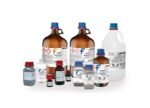
Description
Specifications Table
Product Name – 1,4-Dioxane, 99+%, for spectroscopy
Quantity/Pack Size – 500ML, 1LT, 2.5LT
Form – Liquid
Grade – Spectroscopy
Application – Solvent for UV/Vis, IR, NMR spectroscopy
Product Overview
1,4-Dioxane, 99%+ for spectroscopy is a high-purity solvent engineered for demanding analytical applications where minimal interference is critical. This grade is meticulously refined to eliminate UV-absorbing impurities, ensuring reliable baseline stability and peak resolution in spectroscopic techniques. The solvent’s low water content (<0.05%) and negligible residual metals prevent signal distortion, making it ideal for sensitive instrumentation. Its stable chemical structure resists degradation during prolonged analysis, while the tight quality control guarantees lot-to-lot consistency. The solvent is packaged in amber glass bottles to prevent photodegradation, with PTFE-lined caps to avoid leaching. Compatible with most organic compounds, it serves as a versatile medium for sample preparation without introducing artifacts. The high evaporation rate facilitates rapid sample concentration, while the narrow boiling range (101–102°C) ensures reproducible results. Each batch undergoes GC-MS and UV-Vis validation to confirm purity, with certificates of analysis provided for traceability.
FAQs
1. Can this 1,4-Dioxane be used for HPLC mobile phase preparation?
While primarily designed for spectroscopy, this grade’s low UV cutoff (<210 nm) makes it suitable for HPLC applications requiring high transparency. However, verify compatibility with your column and detector specifications.
2. What is the typical shelf life of unopened 1,4-Dioxane?
When stored in original packaging at room temperature (15–25°C), the solvent remains stable for 24 months. Avoid exposure to direct sunlight or moisture to prevent peroxide formation.
3. How does this compare to ACS-grade 1,4-Dioxane?
Spectroscopy grade undergoes additional purification to remove UV-active impurities, offering superior baseline flatness in spectral analysis. ACS grade may contain trace contaminants acceptable for general lab use but not for sensitive optical measurements.
4. Is this solvent compatible with plastic labware?
1,4-Dioxane can dissolve certain plastics like polystyrene. Use glass or PTFE containers for storage and handling to prevent contamination or container degradation.
5. What precautions should be taken during disposal?
Collect waste in a dedicated solvent waste container and dispose of through licensed hazardous waste handlers. Never pour down drains or evaporate in open systems due to its flammability and potential environmental persistence.