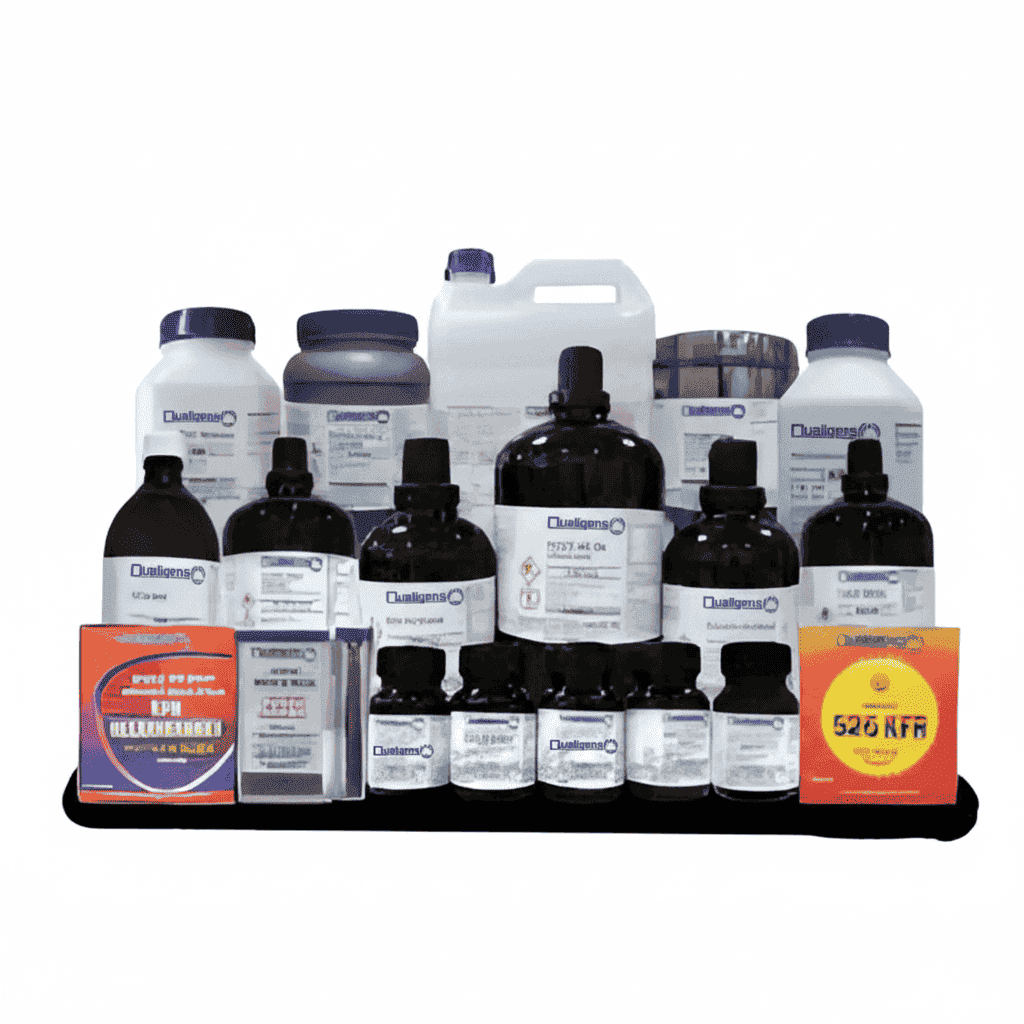
Description
Specifications Table
Product Name – Acetylacetone SQ
Quantity/Pack Size – 500 ML, 2.5 LTR, 5 LTR
Form – Liquid
Grade – AR/LR
Application – Solvent, Cleaning Agent, Extraction, Organic Synthesis
Product Overview
Acetone from eqipped, offered in both Analytical Reagent (AR) and Laboratory Reagent (LR) grades, is an indispensable polar aprotic solvent widely recognized for its exceptional versatility and rapid evaporation. As a highly effective solvent for a broad spectrum of organic compounds, resins, and polymers, it finds extensive use across various scientific disciplines. The AR grade is carefully processed to ensure high purity, low water content, and minimal non-volatile impurities, making it the preferred choice for sensitive analytical applications such as chromatography and spectroscopy, where precision and accuracy are paramount.
The LR grade of Acetone provides a reliable and cost-effective option for general laboratory tasks, including glassware cleaning, dissolving reagents, and as a solvent in numerous organic reactions. Its ability to quickly evaporate without leaving residue makes it an excellent drying agent for laboratory equipment. Acetone is also commonly used in extraction procedures and as a medium for various chemical syntheses. Indian students, researchers, and educators trust eqipped’s Acetone for its consistent quality and dependable performance, which are critical for achieving reproducible results in both routine experiments and complex research projects. Always handle Acetone in a well-ventilated area, away from ignition sources, due to its high flammability. eqipped remains committed to delivering premium-grade lab supplies that support and advance scientific endeavors.
FAQs
1. What are the common uses of Acetone in a chemistry laboratory?
Acetone is commonly used as a general-purpose solvent for organic compounds, an excellent drying agent for glassware, a cleaning agent for laboratory equipment, and as a mobile phase in chromatography.
2. Is Acetone suitable for drying sensitive electronic components?
Acetone can be used for drying some electronic components due to its quick evaporation, but its strong solvent properties mean it could damage certain plastics or coatings. Always test compatibility on a small, inconspicuous area first.
3. What is the flash point of Acetone, and why is it important?
The flash point of Acetone is very low (around -20°C or -4°F), indicating it is highly flammable. This is important because it highlights the need for strict precautions, such as handling in a fume hood and away from ignition sources, to prevent fires or explosions.
4. Can Acetone be recycled or recovered after use in experiments?
Yes, Acetone can often be recovered and recycled through distillation, especially after use as a solvent or cleaning agent. This helps reduce waste and can be more environmentally friendly and cost-effective, depending on the impurities present.
5. How does eqipped ensure the grade purity of its Acetone AR/LR?
eqipped ensures the grade purity of its Acetone AR/LR through comprehensive quality control testing, including assays for purity, determination of water content, assessment of non-volatile residue, and specific impurity analysis, to meet the defined standards for each grade.