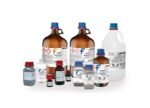
Description
Specifications Table
Product Name – Aluminium chloride, 99.999%, (trace metal basis), for analysis, anhydrous, powder
Quantity/Pack Size – 10GR, 20GR, 100GR
Form – Powder
Grade – 99.999% (trace metal basis), for analysis
Application – Analytical chemistry, synthesis, trace metal analysis
Product Overview
This high-purity 99.999% anhydrous aluminium chloride powder is meticulously refined to meet stringent analytical standards, ensuring minimal trace metal contamination for sensitive laboratory applications. The ultra-fine powder form guarantees rapid dissolution and uniform reactivity, making it indispensable for precise chemical synthesis and quantitative analysis. Its anhydrous nature eliminates moisture interference, providing consistent results in hygroscopic-sensitive reactions. The product undergoes rigorous quality control to maintain its exceptional purity level, with each batch verified for trace metal content to ensure reliability in critical experiments. The powder’s high surface area enhances its catalytic efficiency, while its stable chemical structure ensures long-term storage without degradation. Ideal for researchers requiring ultra-low impurity levels, this aluminium chloride variant delivers unmatched performance in demanding analytical protocols where trace metal interference must be minimized.
FAQs
1. What is the moisture content in this anhydrous aluminium chloride powder?
The product is rigorously dried to maintain anhydrous conditions, with moisture content typically below 0.1% as verified by Karl Fischer titration.
2. Can this be used as a Lewis acid catalyst in organic synthesis?
Yes, the 99.999% purity and anhydrous nature make it highly effective as a Lewis acid catalyst for Friedel-Crafts reactions and other organic transformations.
3. How does the trace metal basis specification affect performance?
The trace metal basis specification ensures that impurities like iron, copper, and nickel are reduced to parts-per-million levels, preventing catalytic interference in sensitive reactions.
4. What is the recommended storage condition to maintain purity?
Store in a tightly sealed container under inert gas (argon/nitrogen) in a desiccator to prevent hydrolysis and moisture absorption.
5. Is this compatible with standard glass laboratory ware?
While compatible, prolonged contact with glass may cause etching; PTFE or polypropylene containers are recommended for long-term storage of solutions.