Description
Specifications Table
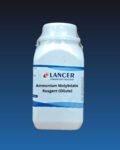
Product Name – Ammonium Molybdate Reagent (Dilute)
Quantity/Pack Size – 500 ml, 125 ml
Form – Liquid (Dilute Solution)
Grade – Laboratory Grade
Application – Analytical Reagent, Qualitative Testing
Product Overview
Ammonium Molybdate Reagent (Dilute) is a specialized laboratory solution formulated for precise analytical applications. This high-purity reagent is essential for qualitative and quantitative testing, ensuring reliable results in various lab procedures. The dilute form enhances usability, making it ideal for standard laboratory protocols. It is commonly employed in chemical analysis, particularly in detecting phosphates and other anions due to its selective reactivity. The reagent is prepared under strict quality controls to maintain consistency and accuracy, meeting the demands of research and educational laboratories. Its stability and clarity make it a preferred choice for experiments requiring exact measurements. Whether used in titration, spectrophotometry, or other analytical techniques, this reagent delivers dependable performance. The solution is packaged in secure, leak-proof containers to preserve its integrity during storage and handling. Equipped with proper labeling, it ensures safe and efficient use in lab environments.
FAQs
1. What is the shelf life of Ammonium Molybdate Reagent (Dilute)?
The reagent typically has a shelf life of 12-24 months when stored under recommended conditions. Always check the label for the exact expiry date.
2. Can this reagent be used for phosphate detection?
Yes, Ammonium Molybdate Reagent (Dilute) is commonly used in phosphate detection assays due to its selective reaction with phosphate ions.
3. Is this reagent compatible with other laboratory chemicals?
It is compatible with most standard lab chemicals, but always verify compatibility before mixing to avoid unintended reactions.
4. How should this reagent be stored?
Store the reagent in a cool, dry place away from direct sunlight and moisture. Keep the container tightly sealed when not in use.
5. Are there any safety precautions for handling this reagent?
Wear appropriate lab safety gear, including gloves and goggles, when handling. Avoid ingestion or contact with skin and eyes.