Description
Specifications
Product Name – Amoeba Model
Quantity/Pack Size – Single Unit
Form – 3D Cellular Replica
Grade – Laboratory Grade
Application – Protist Morphology Observation, Cellular Structure Study, Laboratory Demonstration
product overview
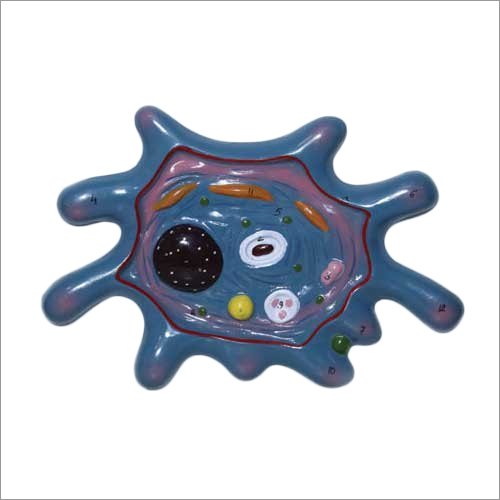
The Amoeba Model is a meticulously crafted, laboratory-grade representation of a unicellular protist designed to provide a highly accurate view of amoeboid structure and morphology. Constructed from durable, non-toxic materials, this 3D model highlights the key features of amoeba, including the nucleus, cytoplasm, contractile vacuole, and pseudopodia, allowing for clear observation of movement and cellular dynamics. Its flexible pseudopodia components are precisely modeled to demonstrate how the amoeba extends and retracts, enhancing the understanding of motility mechanisms. The nucleus and cytoplasmic granules are distinctly colored for optimal visual clarity, making it easy to identify internal structures. Mounted on a stable base, the model ensures durability and secure handling during repeated laboratory use. Lightweight yet robust, the Amoeba Model is suitable for observation, demonstrations, and morphological studies, providing an invaluable visual tool for researchers, educators, and students. The design emphasizes anatomical accuracy, proportional representation, and fine detailing of cellular components. Its compact form allows for easy storage and transport without compromising structural fidelity. Overall, this laboratory-grade Amoeba Model combines realism, durability, and educational utility, offering a precise and visually engaging representation of one of the most fundamental unicellular organisms for detailed cellular observation in lab environments.
FAQs
1. Can this model show pseudopodia movement clearly?
Yes, the model features detailed pseudopodia components for observing extensions and retractions effectively.
2. Is it compatible with other cellular models?
Yes, it can be used alongside other laboratory-grade cellular and protist models for comparative study.
3. How should this model be stored?
Store in a dry, dust-free environment, away from direct sunlight to preserve colors and structural integrity.
4. Are alternative protist models available for purchase?
Yes, models of Paramecium, Euglena, and other single-celled organisms are available for laboratory demonstration.
5. Is the model durable for repeated handling?
Yes, it is made from robust laboratory-grade materials designed for frequent use in laboratory environments.