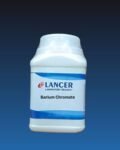
Description
Specifications Table
Product Name – Barium Chromate
Quantity/Pack Size – 500 gm
Form – Powder
Grade – Laboratory Reagent
Application – Analytical chemistry, precipitation reactions
Product Overview
Barium Chromate is a bright yellow, crystalline powder widely used in laboratory settings for its precision in analytical chemistry. This high-purity reagent is insoluble in water but soluble in mineral acids, making it ideal for selective precipitation reactions. Its stability and non-hygroscopic nature ensure long shelf life and consistent performance in qualitative and quantitative analysis. The compound is commonly employed in gravimetric analysis due to its well-defined stoichiometry and minimal interference in reactions. With a molecular formula of BaCrO₄, it serves as a reliable source of chromate ions in controlled experimental conditions. Proper handling is recommended due to its toxic nature, and it should be stored in a cool, dry place away from incompatible substances. This product meets laboratory-grade standards, ensuring accuracy in research and educational applications.
FAQs
1. What is the primary use of Barium Chromate in labs?
Barium Chromate is primarily used in analytical chemistry for precipitation reactions, particularly in gravimetric analysis to determine sulfate or chromate ions.
2. Is Barium Chromate soluble in water?
No, Barium Chromate is insoluble in water but dissolves in mineral acids like hydrochloric acid.
3. What safety precautions should be taken while handling Barium Chromate?
Wear protective gloves, goggles, and a lab coat. Avoid inhalation or ingestion, and work in a well-ventilated area due to its toxic and carcinogenic properties.
4. How should Barium Chromate be stored?
Store in a tightly sealed container in a cool, dry place, away from oxidizing agents and direct sunlight.
5. Are there any alternatives to Barium Chromate for similar applications?
Alternatives like Barium Sulfate or Lead Chromate may be used depending on the specific reaction requirements, but Barium Chromate is preferred for its stability and precision.