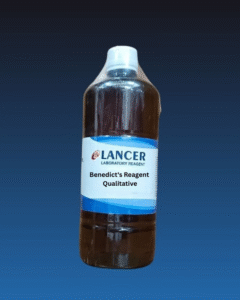
Description
Specifications Table
| Product Name | Benedict’s Reagent Qualitative | 226 | Lancer |
|---|---|
| Pack Size | 125 ml – 500 ml – 5 lit |
| Form | Liquid Solution |
| Grade | Qualitative |
| Application | Sugar detection in biochemical tests |
Product Description
Benedict’s Reagent Qualitative is a trusted solution for detecting reducing sugars in laboratory settings. Whether you’re a student, researcher, or educator, this reagent provides reliable results for qualitative analysis. The solution is formulated to react with sugars, producing a characteristic color change that confirms their presence.
This product is ideal for educational labs, research facilities, and medical testing. The qualitative grade ensures consistency in performance, making it a staple in biochemical experiments. With multiple pack sizes available, you can choose the right quantity for your needs.
When you buy Benedict’s reagent online from eqipped, you get a lab-tested product backed by quality assurance. Our reagent is designed for accuracy, helping you achieve precise results every time. Whether you’re conducting routine tests or advanced research, this solution delivers dependable performance.
Need a reliable Benedict’s reagent for your lab? Order now and ensure accurate sugar detection in your experiments.
The reagent works by reducing copper(II) ions to copper(I) oxide, which forms a red precipitate. This reaction is a key indicator in biochemical assays, making it essential for diabetes research, food testing, and educational demonstrations. The qualitative nature of this reagent makes it perfect for preliminary screening and teaching purposes.
At eqipped, we understand the importance of quality lab supplies. That’s why we offer Benedict’s reagent at competitive prices without compromising on purity or performance. Our user-friendly packaging ensures safe handling and storage, so you can focus on your work without worries.
FAQs
What is Benedict’s reagent used for?
Benedict’s reagent is used to detect the presence of reducing sugars in a solution. It’s commonly used in biochemical tests and educational labs.
How do I store Benedict’s reagent?
Store the reagent in a cool, dry place away from direct sunlight. Keep the bottle tightly sealed to prevent contamination.
Can I use this reagent for quantitative analysis?
This is a qualitative-grade reagent, ideal for detecting sugar presence but not for precise quantification. For quantitative tests, consider specialized reagents.
What safety precautions should I take?
Wear gloves and safety goggles when handling the reagent. Avoid ingestion or skin contact, as it contains copper sulfate.
How long does the reagent last?
When stored properly, Benedict’s reagent remains stable for up to two years. Check the expiration date on the bottle for best results.