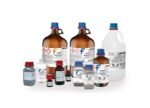
Description
Specifications Table
Product Name – Cadmium chloride, UltraDry™, 99.996% (metals basis)
Quantity/Pack Size – 250g, 50g, 10g, 2g
Form – Anhydrous crystalline powder
Grade – UltraDry™ (99.996% metals basis)
Application – Trace metal analysis, inorganic synthesis, semiconductor research
Product Overview
This UltraDry™ cadmium chloride delivers exceptional 99.996% purity on a metals basis, making it one of the most refined grades available for demanding laboratory applications. The anhydrous form ensures minimal moisture content (<0.005%), eliminating hydration-related variability in sensitive experiments. Packaged under argon in airtight containers, this product maintains its ultra-low moisture specification throughout storage. The crystalline powder dissolves completely in polar solvents without residual particulates, providing consistent performance in spectroscopic and gravimetric analyses. Its trace metal profile meets ACS reagent specifications while exceeding typical commercial grades in cadmium purity. The material's stability under inert conditions makes it particularly suitable for long-term storage without degradation. Each batch undergoes ICP-OES verification to confirm the 99.996% metals basis purity, with certificates of analysis provided for quality assurance. The product's uniform particle size distribution ensures reproducible results in quantitative applications.
FAQs
1. How does the UltraDry™ grade differ from standard cadmium chloride?
The UltraDry™ designation indicates both the 99.996% metals basis purity and the rigorous moisture control during processing and packaging. Standard grades typically contain 0.5-2% water and have lower purity specifications around 98-99%.
2. What precautions are needed when handling this anhydrous form?
This material is extremely hygroscopic and should only be opened in a glove box or under dry nitrogen. Use moisture-free transfer techniques and store with desiccant to prevent hydration.
3. Can this be used as a direct replacement for hydrated cadmium chloride?
No direct substitution is possible due to the different molecular weights. You must recalculate quantities based on the anhydrous CdCl₂ formula weight (183.32 g/mol) versus the hydrate form.
4. What’s the typical shelf life when stored properly?
When kept unopened in its original packaging under argon at room temperature, the product maintains specifications for at least 36 months from the date of manufacture.
5. Are there any known incompatibilities with common lab materials?
The anhydrous form reacts violently with water and strong oxidizing agents. It’s incompatible with brass, copper, and zinc alloys, forming intermetallic compounds over time.