Description
Specifications Table
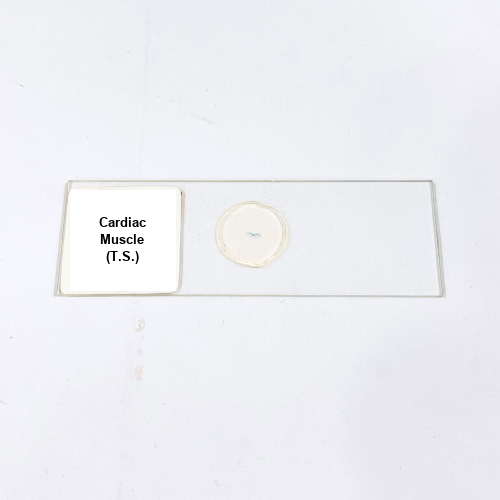
Product Name – Cardiac Muscle (T.S.)
Quantity/Pack Size – Single Slide
Form – Prepared Microscope Slide
Grade – Laboratory Grade
Application – Observation of Heart Muscle Structure and Tissue Arrangement
Product Overview
The Cardiac Muscle (T.S.) prepared slide is an essential tool for observing the intricate structure and organization of cardiac muscle tissue. Expertly sectioned and mounted, this slide allows for detailed visualization of striated muscle fibers, intercalated discs, and branching patterns unique to cardiac tissue. The tissue is stained to enhance the contrast between muscle fibers and connective tissue, ensuring clarity during microscopic examination. The sample is fixed using high-quality reagents that preserve cellular morphology while preventing deterioration over time. The coverslip and mounting medium provide durability and protection against environmental factors such as dust, moisture, and contaminants. The slide’s uniform thickness ensures a consistent viewing experience, minimizing optical distortions when viewed under various magnifications. Manufactured under strict laboratory standards, this slide guarantees reproducibility and sharp imaging, allowing users to study muscle architecture with precision. It is compatible with standard compound microscopes and can be used across various biological studies requiring detailed heart muscle analysis. The Cardiac Muscle (T.S.) slide undergoes rigorous quality checks to ensure that each specimen is suitable for long-term storage and reliable observations. With clear visualization and structural integrity, this prepared slide is an indispensable resource for studying cardiac tissue morphology in laboratory environments.
1. What structures can be observed on this cardiac muscle slide?
The slide shows muscle fibers, intercalated discs, and branching patterns distinctive to cardiac tissue under magnification.
2. Is this slide compatible with all microscope models?
Yes, it is compatible with most standard compound microscopes used in laboratory environments for biological studies.
3. Are other muscle types available for observation?
Yes, slides featuring skeletal and smooth muscle tissues are available for comparative structural analysis.
4. How should the slide be stored to ensure longevity?
It should be stored in a clean, dry, and dust-free environment, away from direct sunlight and moisture to prevent damage.
5. How is the sample preserved for extended use?
The tissue is fixed with high-grade reagents and sealed with a coverslip and mounting medium to protect against contamination and degradation.