
Description
Specifications Table
Material – Borosilicate Glass
Grade – Laboratory Grade
Application – Electron emission studies, thermionic phenomena
Product Overview
Child’s Langmuir’s Law Apparatus is a precision-engineered instrument designed for studying electron emission and thermionic phenomena in controlled laboratory conditions. Constructed from high-quality borosilicate glass, this apparatus ensures durability and resistance to thermal stress, making it ideal for repeated experimental use. The design facilitates accurate measurement of electron current as a function of anode voltage, enabling researchers to verify Child-Langmuir’s law with minimal error. The transparent glass construction allows clear visualization of filament heating and electron flow, enhancing experimental observation. This apparatus is widely used in physics laboratories for demonstrating fundamental principles of electron dynamics, space charge effects, and vacuum tube behavior. The robust build quality ensures long-term reliability while maintaining precision in experimental results. Whether used for educational demonstrations or advanced research, this apparatus provides consistent performance and adherence to theoretical predictions.
FAQs
1. What is the primary purpose of Child’s Langmuir’s Law Apparatus?
This apparatus is used to study electron emission and verify Child-Langmuir’s law, which describes the space-charge-limited current in a vacuum diode.
2. Is this apparatus compatible with standard laboratory power supplies?
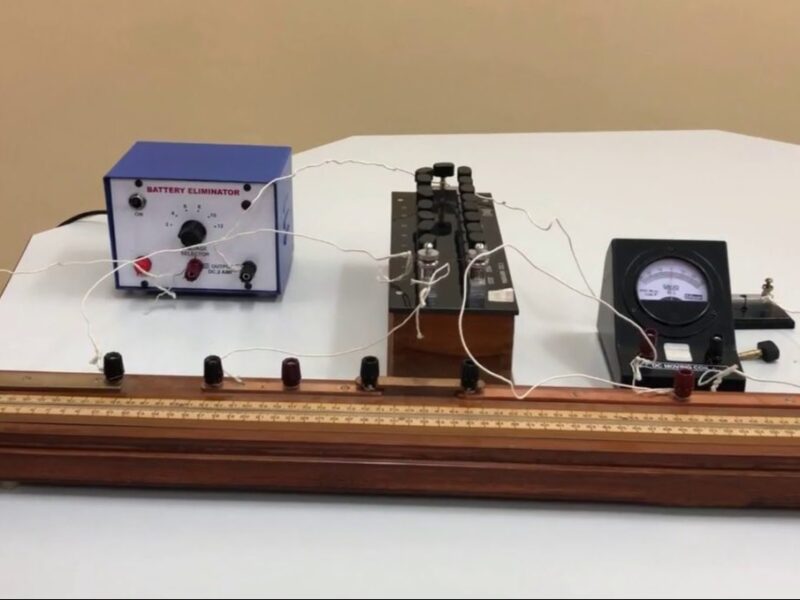
Yes, it is designed to work with common DC power supplies used in physics labs, typically requiring low voltage for filament heating and higher voltage for anode potential.
3. What are the alternatives to this apparatus for similar experiments?
Alternatives include thermionic emission tubes or custom-built vacuum diode setups, though these may require additional calibration and assembly.
4. How should this apparatus be stored when not in use?
Store it in a dry, dust-free environment, preferably in its original packaging or a protective case to prevent damage to the glass components.
5. Where is this apparatus manufactured?
This apparatus is manufactured in India, ensuring compliance with local laboratory standards and quick availability for domestic buyers.