Description
Specifications
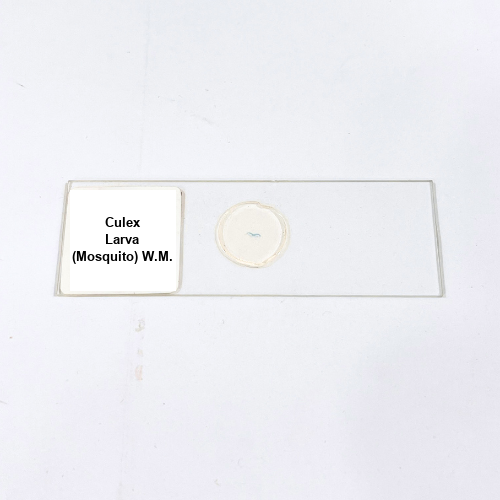
Product Name – Culex Larva (Mosquito) W.M.
Quantity/Pack Size – Standard Pack
Form – Whole Mount Slide
Grade – Laboratory Grade
Application – Microscopic Observation of Mosquito Larval Anatomy
Product Overview
The Culex Larva (Mosquito) whole mount slide offers a high-quality, laboratory-grade specimen designed to preserve and highlight intricate larval structures. This slide provides detailed visualization of the head, thorax, abdomen, siphon, and other key anatomical features, allowing for precise observation under varying magnifications. The larva is mounted to maintain natural posture, ensuring that appendages, setae, and respiratory structures are clearly visible. The preparation uses a specialized mounting medium that enhances transparency, protects delicate tissues, and prevents distortion or degradation over time. Each slide is crafted for durability, enabling repeated handling and examination without compromising specimen integrity. With enhanced clarity and preservation, this Culex Larva slide supports the study of morphological details, providing clear differentiation of structural components. It is an essential laboratory tool for observation, reference, and comparative analysis, ensuring consistent and reliable visualization of mosquito larval anatomy. The slide is prepared to meet high laboratory standards, offering long-lasting performance, stability, and precision for meticulous microscopic studies.
FAQs
1. Is this Culex Larva slide suitable for low-power microscopes?
Yes, it is compatible with both low and high magnification microscopes for detailed observation.
2. How should I store the Culex Larva whole mount slide?
Store in a cool, dry place away from direct sunlight and dust to maintain clarity and preservation.
3. Can this slide be used for comparative larval studies?
Yes, the preserved anatomical details make it ideal for comparative analysis between different mosquito specimens.
4. How durable is the mounting for repeated use?
The laboratory-grade mounting ensures longevity and allows repeated handling without affecting specimen quality.
5. Are all key larval structures visible on this slide?
Yes, head, thorax, abdomen, siphon, and other critical structures are clearly preserved and observable.