Description
Specifications Table
Product Material – High-grade ABS with metal components
Grade – Laboratory/Industrial
Application – DC current measurement, circuit testing, calibration
Range Options – 0-1/2A, 2.5/5A, 5/10A, 10/20A, 15/30A (select any 1 range)
Product Overview
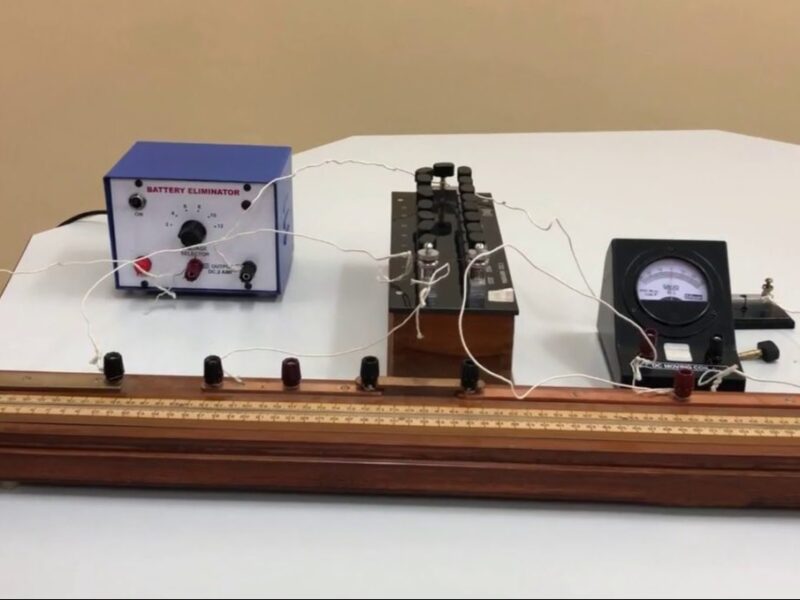
This dual-range DC current meter is engineered for precise current measurement across a wide spectrum of applications, offering selectable ranges from 0-1/2A up to 15/30A to accommodate diverse testing requirements. Constructed with high-grade ABS and reinforced metal components, it ensures durability and long-term reliability in demanding lab environments. The meter features a clear, easy-to-read analog display with calibrated markings for accurate readings, minimizing parallax errors. Its compact design allows for seamless integration into test setups, benchtop experiments, or field applications where space is constrained. The internal shunt resistance is optimized for low power dissipation, ensuring minimal circuit interference while maintaining measurement integrity. Whether used for low-current sensitivity tests or high-current load analysis, this meter delivers consistent performance with a typical accuracy of ±1.5% of full scale. The robust terminal connections support secure wire attachment, preventing accidental disconnections during operation. Ideal for educational labs, research facilities, or industrial quality control, this current meter combines versatility with professional-grade precision, making it an essential tool for any current measurement task.
FAQs
1. How do I select the correct range for my application?
The meter offers multiple range options (0-1/2A to 15/30A). Choose a range where your expected current falls within 30-70% of the full-scale value for optimal accuracy. For example, if measuring 8A, the 10/20A range would be ideal.
2. Can this meter measure AC current or only DC?
This is a DC-specific current meter designed exclusively for direct current measurements. Using it with AC current may damage the internal components and yield inaccurate readings.
3. What’s the difference between this and a digital current meter?
Unlike digital meters, this analog meter provides instantaneous visual feedback without display lag, making it better for observing current fluctuations. It also doesn’t require batteries and is less susceptible to electromagnetic interference in high-noise environments.
4. How should I store this meter when not in use?
Store in a dry, dust-free environment at room temperature (15-30°C). Avoid exposure to direct sunlight or magnetic fields. For long-term storage, keep the terminals shorted to prevent internal component degradation.
5. Is this meter compatible with high-frequency DC signals?
The meter is optimized for standard DC measurements up to 1kHz. For high-frequency or pulsed DC signals, the readings may not be accurate due to the mechanical nature of the analog movement. Consider a true RMS digital meter for such applications.