Description
Specifications Table
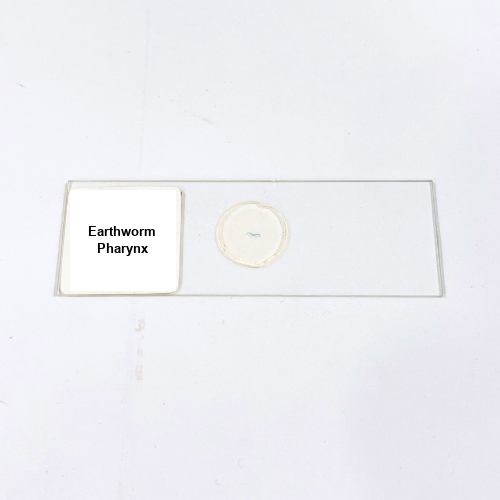
Product Name – Earthworm Pharynx
Quantity/Pack Size – 1 Slide
Form – Transverse Section
Grade – Laboratory Grade
Application – Observation of pharynx structure and detailed microscopic study of invertebrate digestive tissue
Product Overview
The Earthworm Pharynx slide provides a precisely prepared transverse section, revealing the detailed organization of the pharyngeal tissue. This specimen highlights the muscular layers, epithelial lining, and internal lumen, allowing clear visualization of the functional anatomy of the earthworm’s feeding apparatus. The slide is preserved and stained using high-quality laboratory-grade techniques to enhance contrast and definition of cellular and tissue structures. The mounting medium ensures long-term preservation, maintaining the integrity of delicate tissues while minimizing distortion and fading. This preparation allows for detailed observation of muscle arrangements, epithelial characteristics, and associated connective tissues, providing an accurate representation of pharyngeal morphology. Each slide undergoes rigorous quality control to ensure consistent visibility and accurate anatomical representation. The Earthworm Pharynx slide is ideal for laboratory use, offering clarity and precision for morphological studies and tissue examination. Its design ensures that fine structures are easily observable, enabling detailed study and accurate identification of the pharyngeal components, making it a reliable tool for in-depth microscopic analysis.
1. What anatomical features are visible on the Earthworm Pharynx slide?
Muscular layers, epithelial lining, lumen, and connective tissues are clearly visible for detailed microscopic study.
2. Is this slide compatible with standard laboratory microscopes?
Yes, it works seamlessly with conventional optical microscopes for precise observation of tissue structure.
3. Are there alternative slides for digestive system comparison?
Yes, alternatives include Earthworm Oesophagus, Earthworm Gizzard, and Earthworm Typhlosole slides for comparative digestive system studies.
4. How should the slide be stored to preserve quality?
Store in a dry, clean environment, away from direct sunlight and moisture to maintain staining and tissue integrity.
5. Where are the specimens sourced from?
Specimens are sourced from certified laboratory suppliers and prepared under strict laboratory-grade protocols for accuracy and reliability.