Description
Specifications Table
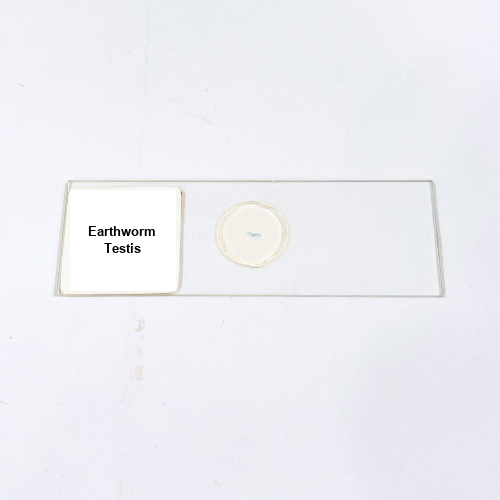
Product Name – Earthworm Testis
Quantity/Pack Size – 1 Slide
Form – Whole Mount
Grade – Laboratory Grade
Application – Microscopic study of invertebrate reproductive anatomy and structure
Product Overview
The Earthworm Testis slide is carefully prepared to present the reproductive anatomy of the earthworm with precise clarity. This laboratory-grade whole mount highlights the paired testis lobes, seminal vesicles, and their connection to the coelomic cavity, allowing observation of the reproductive system in situ. The specimen is mounted to preserve cellular integrity, ensuring that individual cells and tissue structures are clearly visible under standard laboratory microscopes. This detailed slide facilitates examination of testicular lobes, spermatogenic tissue, and accessory structures, providing a thorough understanding of reproductive organization and tissue arrangement in earthworms. High-quality mounting media and coverslip placement maintain long-term specimen stability, preventing air bubbles or distortion. The slide is suitable for repeated observation and study, offering consistent clarity for each use. Its preparation emphasizes precision, enabling accurate visualization of anatomical features and internal arrangements. With its durability and detail, this Earthworm Testis slide is an essential tool for microscopic analysis of invertebrate reproductive structures and overall anatomical understanding in laboratory settings.
1. What anatomical features can be observed in this slide?
The paired testis lobes, seminal vesicles, and coelomic connections are visible for detailed microscopic study.
2. Is this slide compatible with standard microscopes?
Yes, it works effectively with conventional optical microscopes at different magnifications.
3. Are there alternative slides for comparison?
Yes, alternatives include Earthworm Seminal Vesicle, Earthworm Brain Ring, and Earthworm Heart slides.
4. How should the slide be stored to maintain quality?
Keep in a dry, dust-free environment, away from direct sunlight and moisture to preserve specimen clarity.
5. From where are the Earthworm specimens sourced?
Specimens are obtained from verified sources and prepared to maintain laboratory-grade standards for accuracy.