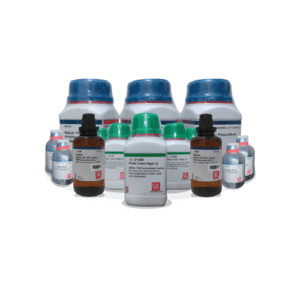
Description
Specifications Table
| Product Name | EDTA Disodium Salt Dihydrate PrimeDx, 98% |
|---|---|
| Pack Size | 1 Kg, 5 Kg, 25 Kg |
| Form | Powder |
| Grade | Lab Grade (98% Purity) |
| Application | Chelation, Molecular Biology, Diagnostic Kits |
Product Description
EDTA disodium salt dihydrate is a versatile chelating agent widely used in laboratories for binding metal ions, preventing oxidation, and stabilizing enzymes. This PrimeDx-grade product ensures 98% purity, making it ideal for sensitive applications like PCR, cell culture, and diagnostic assays.
Whether you’re a student setting up experiments or a researcher optimizing protocols, this EDTA variant offers consistent performance. Its water-soluble nature simplifies preparation, while the dihydrate form enhances stability during storage.
Need bulk quantities? eqipped offers 1 Kg, 5 Kg, and 25 Kg packs for seamless scalability.
Key Applications
- Metal ion sequestration in biochemical assays
- Preventing DNA degradation in molecular biology
- Stabilizing reagents in diagnostic kits
- Industrial water treatment formulations
Why This Grade Matters
PrimeDx certification guarantees minimal impurities, critical for reproducible results. Unlike technical-grade alternatives, this variant meets stringent lab standards, reducing batch-to-batch variability.
Safety Note
Handle with care. Avoid inhalation and direct contact. Use in a well-ventilated area with appropriate PPE.
FAQs
What is the shelf life of EDTA disodium salt dihydrate?
When stored in a cool, dry place, it remains stable for 2–3 years. Keep the container tightly sealed.
Can this be used for food-grade applications?
No, this is a lab-grade product. For food applications, use FDA-approved variants.
How do I prepare a 0.5 M EDTA solution?
Dissolve 186.1 g in 1 L of water, adjust pH to 8.0 with NaOH, and autoclave if needed.
Is this product sterile?
No, but it can be filter-sterilized for aseptic applications.
What’s the difference between disodium and tetrasodium EDTA?
Disodium EDTA is more soluble and commonly used in buffers, while tetrasodium is preferred for alkaline conditions.