Description
Specifications Table
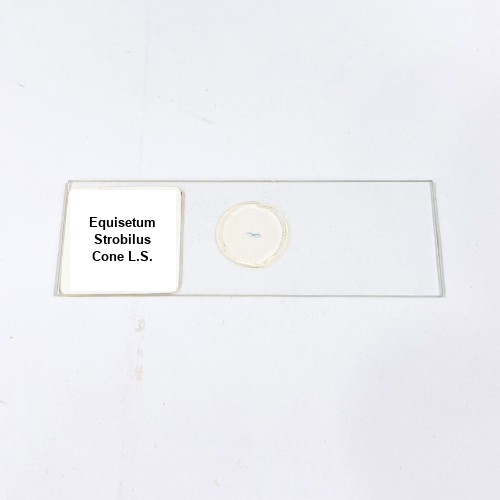
Product Name – Equisetum Strobilus Cone L.S.
Quantity/Pack Size – 1 Slide
Form – Longitudinal Section
Grade – Laboratory Grade
Application – Observation of sporangia arrangement and vascular tissue in Equisetum strobilus under microscope
Product Overview
The Equisetum Strobilus Cone L.S. slide provides a meticulously prepared longitudinal section of the strobilus cone, revealing detailed internal structures including sporangia and the central axis. This laboratory-grade slide highlights the arrangement of sporangia along the cone axis, allowing precise observation of the reproductive and vascular tissues under standard optical microscopes. The section is carefully stained to enhance the contrast of cell walls, sporangial capsules, and surrounding tissue, ensuring clear visibility of morphological details. The slide is mounted with a durable medium that preserves the structural integrity of the specimen, preventing distortion during observation. Each slide undergoes strict quality control to ensure the alignment and clarity of the strobilus tissues, making it ideal for repeated microscopic analysis. The preparation emphasizes the unique characteristics of Equisetum strobilus, such as the distribution of sporangia and the organization of vascular strands, allowing detailed structural studies with high precision. The slide is suitable for laboratory environments where clarity, detail, and reliability are critical, offering a comprehensive view of the cone’s longitudinal anatomy for accurate examination of plant tissue organization.
1. What structures are visible on the Equisetum Strobilus Cone L.S. slide?
Reproductive sporangia, central axis, vascular strands, and tissue organization are clearly visible for detailed study.
2. Can this slide be used with standard optical microscopes?
Yes, it is fully compatible with conventional laboratory microscopes for clear tissue observation.
3. Are there alternative plant slides for comparison?
Yes, alternatives include Lycopodium, Selaginella, and other Equisetum slides for comparative morphological studies.
4. How should the slide be stored to maintain quality?
Keep the slide in a dry, dust-free environment, away from sunlight and moisture to preserve staining and structural integrity.
5. Where are Equisetum specimens sourced from?
Specimens are collected from controlled botanical environments and processed under laboratory protocols to ensure quality and accuracy.