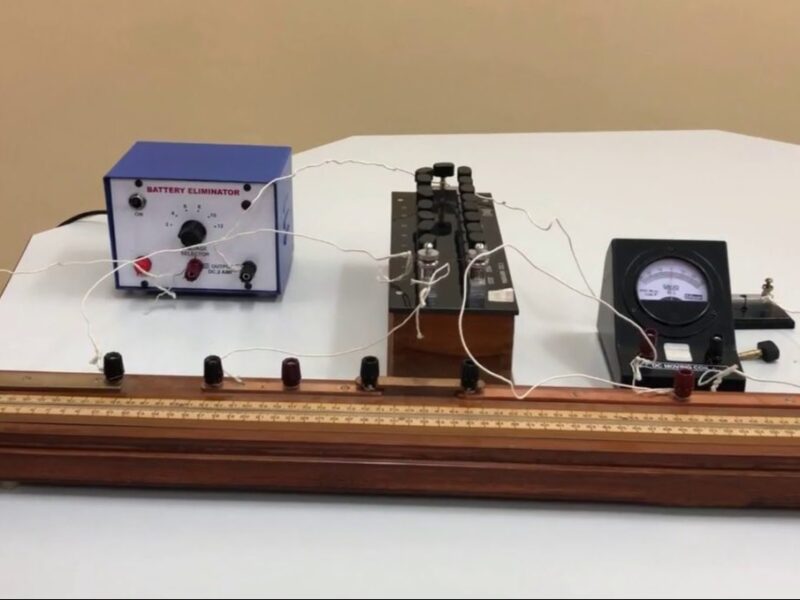
Description
Specifications Table
Product Material – Optical glass, neodymium magnets, aluminum housing
Grade – Laboratory/educational grade
Application – Demonstrating Faraday rotation, magneto-optic studies
Product Overview
This Faraday’s Effect Experiment Setup with Diode Laser is designed to demonstrate the fundamental interaction between magnetic fields and polarized light. The kit includes a high-precision diode laser emitting coherent light, which passes through a specialized optical medium placed within a controlled magnetic field generated by powerful neodymium magnets. As the plane of polarization rotates proportionally to the magnetic field strength, users can observe and measure this phenomenon with clarity. The aluminum housing ensures stability and durability, while the optical glass components maintain high transmission efficiency for accurate results. This setup eliminates external interference, making it ideal for controlled laboratory environments where precision is critical. The diode laser’s narrow beam divergence and consistent wavelength ensure repeatable experiments, while the adjustable magnetic field allows for variable testing conditions. Whether used for qualitative demonstrations or quantitative measurements, this kit provides a robust platform for exploring magneto-optic effects without requiring complex calibration.
FAQs
1. What type of laser is included in this Faraday’s Effect setup?
The setup includes a diode laser optimized for visibility and coherence, typically operating in the red spectrum (630–670 nm) for clear polarization effects.
2. Can this kit measure the Verdet constant?
Yes, the setup allows for Verdet constant measurements by comparing the angle of polarization rotation to the applied magnetic field strength.
3. Is external power required for the magnets?
No, the neodymium magnets in this kit are permanent and do not require an external power source for operation.
4. What is the typical polarization rotation angle achievable?
The rotation angle depends on the magnetic field strength and material properties, but the setup is designed to produce measurable effects (typically a few degrees) for clear observation.
5. How should the optical components be cleaned?
Use a soft, lint-free cloth and isopropyl alcohol (70% or higher) to gently clean the optical surfaces. Avoid abrasive materials to prevent scratches.