Description
Specifications
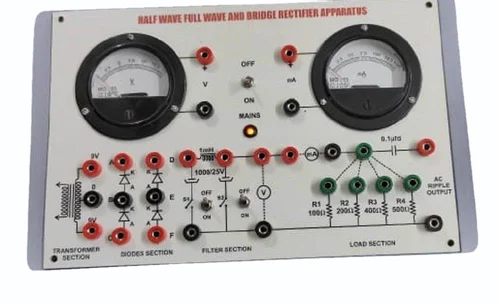
Product Name – Full Wave Rectifier
Quantity/Pack Size – Single Unit
Form – Assembled Electronic Apparatus
Grade – Laboratory Grade
Application – Conversion of AC to DC
product overview
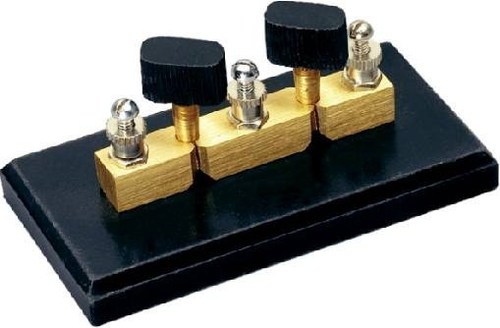
The Full Wave Rectifier is a precision-engineered electronic apparatus designed for consistent performance and dependable operation in controlled environments. Constructed with durable components, it provides stable functionality and ensures that alternating current is effectively converted into direct current with minimal fluctuations. The rectifier features a robust design that incorporates quality-grade diodes, wiring, and connectors, all carefully integrated to maximize efficiency and maintain structural integrity over time.
Its build ensures minimal energy loss, delivering a steady output and dependable reliability. The apparatus is manufactured to laboratory-grade standards, ensuring accuracy in performance and long-term durability. Each unit is tested to meet quality benchmarks, making it a dependable choice for controlled experiments and demonstrations.
The rectifier is designed with a compact structure, allowing ease of handling, secure placement, and safe operation. The assembly ensures stability, minimizing risks of damage during repeated use. With its strong and resilient build, the apparatus remains consistent in performance, even under frequent handling.
The Full Wave Rectifier is known for its precision, strength, and dependable functionality. Its high-grade components make it a long-lasting addition to laboratory setups where reliability and consistency are essential. The well-structured design, combined with rigorous quality checks, ensures that every unit delivers excellent results while maintaining safety and durability. This makes it a professional-quality apparatus that supports accurate and efficient controlled operations.
FAQs
1. What type of current does the Full Wave Rectifier output?
It outputs direct current by converting alternating current through its dual-phase rectification process.
2. Is the Full Wave Rectifier compatible with standard lab setups?
Yes, it is designed to fit into standard laboratory arrangements with ease and safety.
3. How should the Full Wave Rectifier be stored when not in use?
It should be kept in a clean, dry place away from dust and moisture to maintain its performance.
4. Are there alternative rectifiers available for different applications?
Yes, half-wave rectifiers and bridge rectifiers are alternatives, depending on the specific requirements of the setup.
5. What safety measures should be taken during operation?
It should be used on a stable surface with secure connections, avoiding overloading or exposure to moisture.