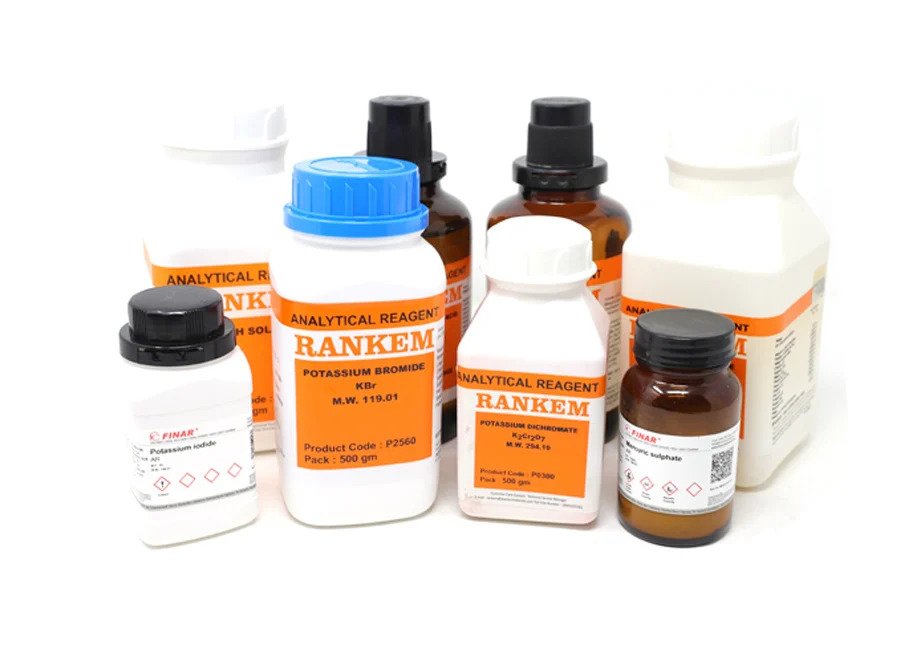
Description
Specifications Table
Product Name – Hydrochloric Acid (35–38%)
Quantity/Pack Size – 500 mL / 1 L / 2.5 L
Form – Liquid (fuming)
Grade – Analytical / Reagent
Application – Digestion, titration, pH adjustment
Product Overview
This 35–38% hydrochloric acid is a highly concentrated, lab-grade reagent designed for demanding applications requiring strong mineral acids. Its ultra-pure formulation ensures minimal metallic impurities, making it suitable for trace analysis, acid digestion of organic samples, or precise pH adjustments. The fuming liquid is packaged in HDPE bottles with secure caps to prevent leaks and vapor exposure, though it should always be handled in a fume hood with proper PPE. The analytical grade adheres to strict quality controls, guaranteeing consistency in titrations, metal dissolution, or cleaning glassware. Its high reactivity necessitates careful dilution—always add acid to water—to avoid exothermic hazards. The reagent’s stability under standard storage conditions (cool, ventilated areas) extends its shelf life, though prolonged exposure to air may lead to concentration changes. Available in 500 mL, 1 L, and 2.5 L sizes, it accommodates both small-scale experiments and bulk processes. Whether used for dissolving oxides, adjusting reaction media, or regenerating ion-exchange resins, this HCl delivers reliable performance with minimal residual contamination.
FAQs
1. What safety precautions are essential when handling 35–38% HCl?
Wear acid-resistant gloves, goggles, and a lab coat; work in a fume hood to avoid inhalation of vapors.
2. Can this HCl be used for etching metals?
Yes, but dilution may be required depending on the metal type and desired etch rate.
3. How do I verify the concentration of this acid?
Titrate with a standardized sodium hydroxide solution using phenolphthalein as an indicator.
4. What is the shelf life of unopened hydrochloric acid?
Indefinite if stored properly, though concentration may slightly decrease over years due to HCl volatility.
5. Are there less hazardous alternatives for pH adjustment?
For mild adjustments, consider acetic acid or citric acid, though they lack HCl’s strength for digestion.